Other grades of this product :
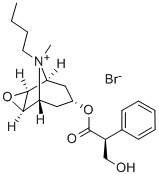
| Scopolamine butylbromide Basic information |
| Scopolamine butylbromide Chemical Properties |
| Melting point | 142-1440C | | alpha | D20 -20.8° (c = 3 in water) | | storage temp. | 2-8°C | | solubility | H2O: 50 mg/mL | | form | powder | | color | white | | optical activity | [α]25/D 20.8°, c = 3 in H2O(lit.) | | CAS DataBase Reference | 149-64-4(CAS DataBase Reference) |
| Hazard Codes | Xn | | Risk Statements | 22 | | WGK Germany | 3 | | RTECS | YM3500000 | | Toxicity | LD50 in mice (mg/kg): 15.6 i.v.; 74 i.p.; 570 s.c.; 3000 orally (Stockhaus, Wick) |
| Scopolamine butylbromide Usage And Synthesis |
| Chemical Properties | Crystalline Solid | | Originator | Butylscopolamine,China Pharm | | Uses | Anticholinergic. Antispasmodic | | Uses | (?)-Scopolamine N-butyl bromide was used as standard in designing a procedure for quantification of compounds using CE-MS.8 | | Manufacturing Process | 1300 g of scopolamine base and 350 g of n-butylbromide in 600 ml
acetonitrile is heated at 65°C for 160 hours. The oil obtained is dissolved in
methanol. The solution is cooled and crystalline scopolamine N-n-butylbromide
is filtered. After recrystallization from methanol was obtained scopolamine N-n-butylbromide with melting point 142-144°C and [α]d
20 = -20.5° (3%
solution in water); yield 65%. | | Therapeutic Function | Anticholinergic, Spasmolytic, Antitussive | | Biochem/physiol Actions | Competitive muscarinic acetylcholine receptor antagonist; antispasmodic. | | Clinical Use | Symptomatic relief of gastrointestinal or genitourinary
disorders due to smooth muscle spasm
Bowel colic
Excessive respiratory secretions | | Drug interactions | Potentially hazardous interactions with other drugs
None known | | Metabolism | The main metabolic pathway is the hydrolytic cleavage
of the ester bond. Orally administered hyoscine
butylbromide is excreted in the faeces and in the
urine. Studies in man show that 2-5% of radioactive
doses is eliminated renally after oral, and 0.7-1.6%
after rectal administration. Approximately 90% of
recovered radioactivity can be found in the faeces after
oral administration. The urinary excretion of hyoscine
butylbromide is less than 0.1% of the dose. The
metabolites excreted via the renal route bind poorly to muscarinic receptors and are therefore not considered to
contribute to the effect of the hyoscine butylbromide. |
| Scopolamine butylbromide Preparation Products And Raw materials |
|


 日本语
日本语 한국어
한국어 Français
 Deutsch
 España
 Türkiye