Other grades of this product :
| Cyclopentadecanolide Basic information |
| Cyclopentadecanolide Chemical Properties |
| Melting point | 34-38 °C(lit.) | | Boiling point | 137 °C2 mm Hg(lit.) | | density | 0.918 g/mL at 25 °C(lit.) | | vapor pressure | 0.085Pa at 25℃ | | FEMA | 2840 | OMEGA-PENTADECALACTONE | | refractive index | 1.4700 | | Fp | >230 °F | | storage temp. | Sealed in dry,Room Temperature | | solubility | Chloroform, Ethyl Acetate, Methanol (Slightly) | | form | Solid | | color | White to Off-White Low Melting | | Water Solubility | Soluble in alcohol, dipropylene glycol. Insoluble in water. | | Merck | 14,3910 | | JECFA Number | 239 | | BRN | 143710 | | LogP | 5.79 at 25℃ | | CAS DataBase Reference | 106-02-5(CAS DataBase Reference) | | NIST Chemistry Reference | Oxacyclohexadecan-2-one(106-02-5) | | EPA Substance Registry System | Oxacyclohexadecan-2-one (106-02-5) |
| Safety Statements | 24/25 | | WGK Germany | 1 | | RTECS | RN9775000 | | TSCA | Yes | | HS Code | 29322090 | | toxicity | Both the acute oral LD50 value in rats and the acute dermal LD50 value in rabbits exceeded 5 g/kg (Levenstein, 1974). |
| Cyclopentadecanolide Usage And Synthesis |
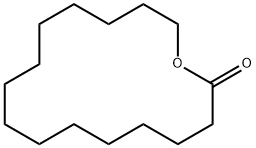
| Chemical Properties | white crystalline low melting solid | | Chemical Properties | Cyclopentadecanolide occurs in small quantities in,
for example, angelica root oil. It forms colorless crystals (mp 37–38°C) with a
delicate, musk-like odor. | | Chemical Properties | ω-Pentadecalactone has an extraordinarily persistent, musk-like odor. | | Occurrence | Originally reported found in the essential oil from angelica roots. | | Uses | As a fixative in perfumery. | | Uses | Pentadecanolide is a monomer used to make PGA-co-pentadecalactone polymers to be used in the development of directly compressed prolonged release tablets of slightly soluble drugs such as ketoprofen. | | Uses | Pentadecanolide may be used for the synthesis of poly(pentadecanolide) (PPDL) by Novozyme 435 catalyzed ring-opening polymerization. It may be employed as starting reagent for the synthesis of terminally-branched iso-fatty acids (iso-C15-C17). | | Preparation | The main industrial syntheses start from compounds produced
from cyclododecatriene: either by ring expansion of cyclododecanone or
by depolymerization of polyesters of 15-hydroxypentadecanoic acid (from
1,12-dodecanediol). | | Aroma threshold values | Detection: 1 to 4 ppb | | Taste threshold values | Taste characteristics at 75 ppm: vanilla bean, powdery helioropine, creamy and licorice. | | Synthesis Reference(s) | Tetrahedron Letters, 34, p. 6107, 1993 DOI: 10.1016/S0040-4039(00)61741-0The Journal of Organic Chemistry, 50, p. 2394, 1985 DOI: 10.1021/jo00213a044 | | General Description | Pentadecanolide is one of the major components, isolated from the root of Angelica archangelica L., species. It is a synthetic musk, which exists as a widespread contaminant in the environment. | | Flammability and Explosibility | Nonflammable | | Trade name | Macrolide® (Symrise), Exaltolide®, Exaltolide®Total (Firmenich),
Pentalide (Soda Aromatic). | | Purification Methods | It has been recrystallised from MeOH (4 parts) at -15o. [Hundieck |
| Cyclopentadecanolide Preparation Products And Raw materials |
|


 日本语
日本语 한국어
한국어 Français
 Deutsch
 España
 Türkiye