Other grades of this product :
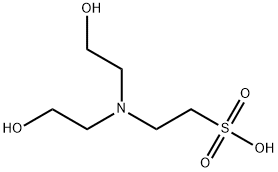
| Product Name: | BES | | Synonyms: | BES ULTRAPURE;N,N-Bis(2-hydroxyethyl)-2-aminoethanesulphonic acid >99%;N,N-Bis(2-hydroxyethyl)-2-aminoethanesulfonic Acid [Good's buffer component for biological research];N,N-Bis(2-hydroxyethyl)-2-aminoethanesulfonic acid, N,N-Bis(2-hydroxyethyl)taurine;Bes, 99+%, for biochemistry;BES, for biochemistry;2-[N,N-Bis(2-hydroxyethyl)amino]ethanesulfonic acid (BES);Ethanesulfonic acid, 2-[bis(2-hydroxyethyl)amino]- | | CAS: | 10191-18-1 | | MF: | C6H15NO5S | | MW: | 213.25 | | EINECS: | 233-465-5 | | Product Categories: | Biochemistry;Good's Buffers;Pharmaceutical Intermediates;Buffer | | Mol File: | 10191-18-1.mol |
| Hazard Codes | Xi | | Risk Statements | 36/37/38 | | Safety Statements | 26 | | WGK Germany | 3 | | RTECS | KI7363500 | | TSCA | Yes | | HS Code | 29221980 |
| Description | BES is a zwitterionic buffer that is used in biochemistry and molecular biology research. It is one of the "Good" buffers developed in the 1960's to provide buffers in the pH range of 6.15 - 8.35 for wide applicability to biochemical studies. The pioneering publication by Good and co-workers describes the synthesis of BES and its physical properties.A protocol has been reported for the use of BES buffered saline in the calcium phosphate mediated transfection of eukaryotic cells with plasmid DNA. An investigation has been published on the interaction of BES and other amine buffers with DNA and the measurement of these complexes by free solution capillary electrophoresis.The effect of BES and other zwitterionic buffers on the bicinchoninic acid (BCA) measurement of microgram quantities of protein has been studied. BES was found to diminish color development of the proteinBCA complex by 30-35% at 50 mM, and by <10% at 5 mM, measuring in the 1-10 mg range of BSA against protein-BCA complexes formed in water. This color loss may result from binding of Cu2+ to BES. | | Chemical Properties | White/clear cryst. powder | | Uses | BES buffer is suitable for use in systems where a calcium phosphate-DNA complex formation is desirable (Absorbance: <0.05 at 260 nm, 100 mM). Chen and Okayama describe an improved transfection system for the stable transformation of cells with plasmid DNA using BES buffer. The slow formation appears to be the most critical factor contributing to the high efficiency of stable transformations. Has a pKa of 7.12 at 20°C. Absorbance (100 mM, 260 nm):≤0.05.BES buffer is suitable for use in systems where a calcium phosphate-DNA complex formation is desirable. Chen and Okayama described an improved transfection system for the stable transformation of cells with plasmid DNA using BES buffer. The gradual formation of the calcium phosphate-DNA complex and its slow precipitation onto cells appears to be the most critical factor contributing to the high efficiency of stable transformations. | | Uses | BES is used as a buffer to maintain the pH of the solutions in biological experiments. It is useful for diagnostic assay manufacturing industry. It induces cross-linking between sulfonated polyimide chains in sulfonated polyimide membranes. It acts as biobuffer to investigate the aqueous medium self-assembly of heterometallic CuII/Li 3D coordination polymers. | | Uses | BES may be employed as binding buffer in modified Eagle′s medium during the binding assay of human melanoma cells. It may be used as biobuffer to investigate the aqueous medium self-assembly of heterometallic CuII/Li 3D coordination polymers. | | Application | BES, or N,N-Bis(2-hydroxyethyl)-2-aminoethanesulfonic acid, can be used to study molecular biology, biological buffers, molecular biology reagents and zwitterionic compounds. BES has been used to study versatile catalyst precursors for mild hydrocarboxylation of alkanes to carboxylic acids. BES has also been used to determine that saline and buffers minimize the action of interfering factors in the bacterial endotoxins test.BES is a useful secondary standard biochemical buffer. Useful pH range for BES is 6.4 to 7.8. It is useful for diagnostic assay manufacturing industry. BES, a sulfonic acid-containing cross-linking agent, induces cross-linking between sulfonated polyimide chains in sulfonated polyimide membranes. | | General Description | BES (N,N-bis(2-hydroxyethyl)-2-aminoethanesulfonic acid) is a useful secondary standard biochemical buffer. Useful pH range for BES is 6.4 to 7.8. It is useful for diagnostic assay manufacturing industry. BES, a sulfonic acid-containing cross-linking agent, induces cross-linking between sulfonated polyimide chains in sulfonated polyimide membranes. | | Flammability and Explosibility | Notclassified | | Purification Methods | Crystallise BES from aqueous EtOH. [Beilstein 4 IV 3290.] |
| BES Preparation Products And Raw materials |
|


 日本语
日本语 한국어
한국어 Français
 Deutsch
 España
 Türkiye