Other grades of this product :
| o-Anisaldehyde Chemical Properties |
| Melting point | 34-40 °C(lit.) | | Boiling point | 238 °C(lit.) | | density | 1.127 g/mL at 25 °C(lit.) | | refractive index | 1.5608 | | FEMA | 4077 | O-ANISALDEHYDE | | Fp | 244 °F | | storage temp. | 2-8°C | | solubility | Solubility Slightly soluble in water; soluble in ethanol | | form | Low Melting Crystalline Mass | | color | Light yellow to pale brown | | Specific Gravity | 1.127 | | PH Range | Non1 uorescence (3.1) to green 1 uorescence (4.4) | | Water Solubility | insoluble | | Sensitive | Air Sensitive | | JECFA Number | 2062 | | BRN | 606301 | | Major Application | Battery, hair dyes, bird repellents, cosmetics, antibacterial, antipyretic | | CAS DataBase Reference | 135-02-4(CAS DataBase Reference) | | NIST Chemistry Reference | Benzaldehyde, 2-methoxy-(135-02-4) | | EPA Substance Registry System | Benzaldehyde, 2-methoxy- (135-02-4) |
| Hazard Codes | Xi | | Risk Statements | 36/37/38-36/38 | | Safety Statements | 26-36-37/39 | | WGK Germany | 2 | | RTECS | BZ2610000 | | F | 9-23 | | TSCA | Yes | | HS Code | 29124900 | | Toxicity | LD50 orally in Rabbit: 2500 mg/kg LD50 dermal Rabbit > 5000 mg/kg |
| o-Anisaldehyde Usage And Synthesis |
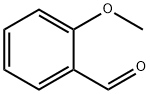
| Description | O-Anisaldehyde (also 2-methoxybenzaldehyde) is found in cassia oil, cinnamon bark, and cinnamon bark oil. It is a clear colorless liquid with a strong aroma.
O-Anisaldehyde is used as a flavor agent in foods including nonalcoholic/alcoholic beverages, baked goods, chewing gum, confections, frozen dairy, fruit ices, hard/soft candy, instant coffee, tea, Jams, jellies, and milk products. O-Anisaldehyde has been used to examine the acaricidal activity of Periploca sepium oil and its active component against Tyrophagus and to obtain good enantioselectivities using Cu(OAc)(2)-bis(oxazolines) via hydrogen bonding in asymmetric Henry reaction.
| | References | [1] George A. Burdock (2016) Fenraoli’s Handbook of Flavor Ingredients, Sixth Edition.
[2] https://www.alfa.com/en/catalog/A10770/
| | Description | o-Methoxybenzaldehyde has a faint, sweet, floral odor. It blends
well with cassia. It has a spice-like flavor, quite bitter above 30 -
40 ppm. May be prepared from salicylaldehyde and dimethyl sulfate in weak alkaline solution. | | Chemical Properties | Colorless to cream amber crystalline powder; sweet powdery hawthorn guaiacol vanilla acetophenone almond aroma. | | Chemical Properties | light yellow to pale brown | | Occurrence | Reported found in Cassia oil, cinnamon bark, and Cinnamon bark oil (Cinnamomum zeylanicum Blume), Sri
Lanka (0.09–0.15%) | | Uses | 2-Methoxybenzaldehyde has been used to examine the acaricidal activity of Periploca sepium oil and its active component against Tyrophagus. It has also been used to obtain good enantioselectivities using Cu(OAc)(2)-bis(oxazolines) via hydrogen bonding in asymmetric Henry reaction. | | Uses | Intermediate. | | Uses | 2-Methoxybenzaldehyde has been used to obtain good enantioselectivities using Cu(OAc)(2)-bis(oxazolines) via hydrogen bonding in asymmetric Henry reaction. | | Aroma threshold values | Medium strength odor; anisic type; recommend smelling in a 10.00% solution or less.
| | Taste threshold values | Sweet powdery guaiacol musty vanilla floral almond taste at 50 ppm in water. | | Synthesis Reference(s) | Journal of Heterocyclic Chemistry, 11, p. 943, 1974 DOI: 10.1002/jhet.5570110616Tetrahedron Letters, 25, p. 1843, 1984 DOI: 10.1016/S0040-4039(01)90056-5 | | Biochem/physiol Actions | Naturally-occurring aromatic aldehyde with acaricidal activity. May condense with L-tryptophan in foods to form the corresponding phenolic tetrahydro-β-carboline-3-carboxylic acid which is a potent antioxidant. | | Safety Profile | Moderately toxic by
ingestion. A skin irritant. Mutation data
reported. Combustible liquid. When heated
to decomposition it emits acrid smoke and
irritating fumes. |
| o-Anisaldehyde Preparation Products And Raw materials |
|


 日本语
 한국어
 Français
 Deutsch
 España
 Türkiye