Other grades of this product :
| Magnolol Chemical Properties |
| Melting point | 101.5-102° | | Boiling point | 180°C/1mmHg(lit.) | | density | 1.107±0.06 g/cm3(Predicted) | | FEMA | 4559 | MAGNOLOL | | storage temp. | Sealed in dry,2-8°C | | solubility | ethanol: soluble1mg/mL | | form | neat | | pka | 9.49±0.43(Predicted) | | color | White to Almost white | | λmax | 292nm(EtOH)(lit.) | | Merck | 14,5697 | | JECFA Number | 2023 | | CAS DataBase Reference | 528-43-8(CAS DataBase Reference) |
| Magnolol Usage And Synthesis |
| Description | Magnolol is an organic compound belonging to lignan. It is a kind of
bioactive compounds identified from the bark of the Magnolia
officinalis or M. grandiflora. It has been supplemented to Asian
traditional medicine for the treatment of anxiety, sleep disorders,
and allergic disease. It can act on the GABA receptor in vitro as a
strong allosteric modulator. It also has antifungal effect, anti-
periodontal activity as well as many osteoblast-stimulating and
osteoclast-inhibiting activities. It has also found that magnolol
can also activate the cannabinoid (CB) receptors. | | References | https://en.wikipedia.org/wiki/Magnolol
https://www.caymanchem.com/product/14233
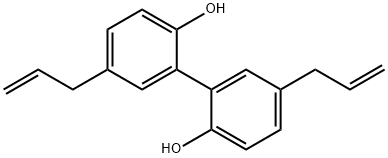
| | Description | Magnolol is a bioactive compound isolated from the bark of M. officinalis that has been used in Asian traditional medicine for the treatment of anxiety, sleep disorders, and allergic diseases. Magnolol can activate cannabinoid (CB) receptors, behaving as a partial agonist with selectivity for the peripheral CB2 subtype (EC50 = 3.28 μM; Ki = 1.44 μM) versus central CB1 (EC50 = 18.3 μM; Ki = 3.15 μM). | | Chemical Properties | White or off-white powder | | Hazard | Moderately toxic by ingestion. | | Biological Activity | Magnolol, a natural lignan isolated from the stem bark of Magnolia officinalis, is a dual agonist of both RXRα and PPARγ, with EC50 values of 10.4 μM and 17.7 μM, respectively. | | Mechanism of action | Magnolol (5,5’-diallyl-2,2’-dihydroxybiphenyl) is a polyphenolic binaphthalene compound and a structural isomer of honokiol. Both magnolol and honokiol are isolated from the stem bark of a traditional Chinese herbal medicine Magnolia officinalis, which has been used for management of nervous disturbance, abdominal distention or disorders, gastrointestinal food stagnancy, and coughing and dyspnea. Magnolol has showed a wide spectrum of beneficial activities, including anti-inflammation, antimicroorganism, antioxidation, antiangiogenesis, anticancer, neuroprotection, cardiovascular protection, and lipolysis activities. | | Safety Profile | Moderately toxic by ingestion.When heated to decomposition it emits acrid smoke andirritating vapors. | | in vitro | Magnolol is a bioactive lignin found in the bark of the Houpu magnolia (Magnolia officinalis) which shows antifungal properties. Magnolol preferentially increases (3)H-muscimol binding to hippocampus compared to cortex and cerebellum in vitro. Magnolol has a more potent enhancing effect on GABAA receptor alpha2 subunit. Magnolol shows significant inhibitory activities against Trichophyton mentagrophytes, Microsporium gypseum, Epidermophyton floccosum, Aspergillus niger, Cryptococcus neoformans, and Candida albicans with minimum inhibitory concentrations (MIC) in a range of 25-100 μg/ml. | | in vivo | Magnolol (5-15 mg/kg, p.o.) significantly attenuates the phenotypic severity of dextran sulfate sodium (DSS)-induced colitis in mice. Magnolol (10, 15 mg/kg, p.o.) attenuates histopathological changes and myeloperoxidase activity in the colon of DSS-treated mice, decreases DSS-induced high levels of proinflammatory cytokines TNF-α, IL-1β and IL-6 in the colonic tissues. Magnolol (10 mg/kg, p.o.) also reverses abnormality of serum metabolome, and regulates tryptophan metabolic pathway in mice. |
| Magnolol Preparation Products And Raw materials |
| Raw materials | 2-Naphthalenemethanol, decahydro-8-[(2'-hydroxy-5,5'-di-2-propen-1-yl[1,1'-biphenyl]-2-yl)oxy]-α,α,4a,8-tetramethyl-, (2R,4aR,8R,8aR)- |
|


 日本语
日本语 한국어
한국어 Français
 Deutsch
 España
 Türkiye