Other grades of this product :
| Tolcapone Basic information |
| Tolcapone Chemical Properties |
| Melting point | 126-1280C | | Boiling point | 485.6±45.0 °C(Predicted) | | density | 1.419±0.06 g/cm3(Predicted) | | storage temp. | 2-8°C | | solubility | DMSO: ≥15mg/mL | | pka | 4.78±0.38(Predicted) | | form | powder | | color | yellow | | Stability: | Stable for 1 year from date of purchase as supplied. Solutions in DMSO or ethanol may be stored at -20°C for up to 2 months. | | CAS DataBase Reference | 134308-13-7(CAS DataBase Reference) |
| Hazard Codes | N | | Risk Statements | 50 | | Safety Statements | 61 | | RIDADR | UN 3077 9 / PGIII | | RTECS | PC4952500 | | HS Code | 2914710000 |
| Tolcapone Usage And Synthesis |
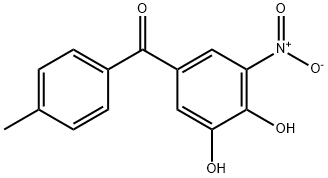
| Description | Tolcapone (134308-13-7) is a catechol O-methyltransferase inhibitor (COMT), inhibiting both brain and peripheral enzymes.1?Potent inhibitor of alpha-synuclein and beta-amyloid oligomerization and fibrillogenesis protecting against extracellular toxicity.2?Binds to transthyretin (TTR) with high affinity (21 to 58 nM) and inhibits TTR aggregation in human plasma and prevents TTR-induced cytotoxicity?in vitro. Stabilizes TTR in mice and humans?in vivo.3?Inhibits O-methylation of exogenous polyphenols such as EGCG.4?Cell permeable. Orally bioavailable. | | Chemical Properties | Yellow Solid | | Originator | Tasmar,Roche | | Uses | Orally active inhibitor of central and peripheral catechol-O-methyltransferase (COMT). Antiparkinsonian | | Uses | Tolcapone may be used in COMT-mediated cell signaling studies.Tolcapone has been used in methyltransferase assay in human embryonic kidney 293 cells. | | Preparation | preparation by demethylation of 4-hydroxy-3-methoxy-4′-methyl-5-nitrobenzophenone with hydrobromic acid in refluxing aque-ous acetic acid. | | Manufacturing Process | Condensation of 4-benzyloxy-3-methoxybenzaldehyde with 4-lithium-toluene
(prepared from 4-bromotoluene and butyl lithium) leads to the corresponding
benzhydrole. Oxidation of the new formed hydroxyl in benzhydrole gives the
4-benzyloxy-3-methoxyphenyl)-p-tolylmethanone. Treatment of this
compound with hydrogen bromide selectively removes the benzyl ether that is
additionally activated by the transannular carbonyl group. The intermediate is
then nitrated under standart conditions to give the (4-hydroxy-3-methoxy-5-
nitrophenyl)-p-tolylmethanone. A second treatment of the last compound with
hydrogen bromide cleaves the ether group, which is now activated by the
adjacent nitro group. This last step affords the (3,4-dihydroxy-5-nitrophenyl)(4-methylphenyl)methanone. | | Therapeutic Function | Antiparkinsonian | | General Description | Tolcapone, 3,4-dihydroxy-4'-methyl-5-nitrobenzophenone (Tasmar), is a yellow, odorless, nonhygroscopic,crystalline compound (pKa=4.78). Tolcapone israpidly absorbed after oral administration. Tolcapone ishighly bound to plasma albumin (>98%), and its distributionis therefore restricted. Tolcapone has low first-pass metabolism.It is almost completely metabolized in the liver before excretion, and 60% is excreted by the kidney. The majormetabolite of tolcapone is an inactive glucuronide conjugate.COMT inhibitors increase chronotropic and arrhythmogeniceffects of epinephrine.Tolcapone is indicated as an adjunctto levodopa/carbidopa for the management of signs andsymptoms of PD. | | Biochem/physiol Actions | Tolcapone is an orally active catechol-O-methyltransferase (COMT) inhibitor. It inhibits both central and peripheral COMT. Tolcapone crosses the blood-brain barrier, and has been used for L-DOPA adjunct therapy in the treatment of Parkinson′s Disease. | | Clinical Use | Catechol-o-methyltransferase inhibitor: Treatment of Parkinson’s disease | | Drug interactions | Potentially hazardous interactions with other drugs
Antidepressants: avoid with MAOIs. | | Metabolism | Extensively metabolised, mainly by conjugation to
the inactive glucuronide, but methylation by catecholO-methyltransferase to 3-O-methyltolcapone and
metabolism by cytochrome P450 isoenzymes CYP3A4
and CYP2A6 also occurs.
Approximately 60% of a dose is excreted in the urine with
the remainder appearing in the faeces. | | References | 1) Manisto?et al.?(1992),?Different in vivo properties of three new inhibitors of catechol O-methyltransferase in the rat; Br, J. Pharmacol.,?105?569
2) Giovanni?et al.?(2010),?Entacapone and tolcapone, two catechol O-methyltransferase inhibitors, block fibril formation of alpha-synuclein and beta-amyloid and protect against amyloid-induced toxicity;?J. Biol. Chem.,?285?14941
3) Sant’Anna?et al.?(2016),?Repositioning tolcapone as a potent inhibitor of transthyretin amyloidogenesis and associated cellular toxicity; Nat. Commun.,?7?10787
4) Forester and Lambert (2015),?The catechol-O-methyltransferase inhibitor, tolcapone, increases the bioavailability of unmethylated (-)-epigallocatechin-3-gallate in mice; Funct. Foods,?17?183 |
| Tolcapone Preparation Products And Raw materials |
|


 日本语
日本语 한국어
한국어 Français
 Deutsch
 España
 Türkiye