Other grades of this product :
| ALIZARIN COMPLEXONE Basic information |
| ALIZARIN COMPLEXONE Chemical Properties |
| Hazard Codes | Xi | | Risk Statements | 36/37/38 | | Safety Statements | 24/25-36-26 | | WGK Germany | 3 | | RTECS | AH0585000 | | TSCA | Yes | | HS Code | 29225090 |
| ALIZARIN COMPLEXONE Usage And Synthesis |
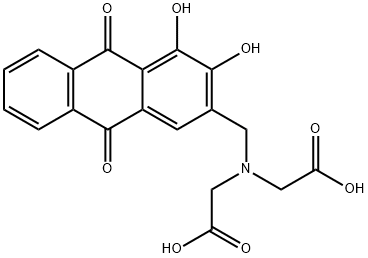
| Description | Alizarin-3-methyliminodiacetic acid is a colorimetric dye for the detection of fluoride ions. It reacts with fluoride to form a lilac-blue complex which can be quantified colorimetrically at 620 nm to determine fluoride concentration. Alizarin-3-methyliminodiacetic acid has been used to visualize fluoride deposition and bone mineralization during development in medaka larvae. It is also an inhibitor of inducible nitric oxide synthase (iNOS; IC50 = 35 nM). | | Chemical Properties | Brown-orange crystals, insoluble in water | | Uses | Alizarin Complexone is used for the determination of fluorine and other anions. ATA is also a potent inhibitor of protein-nucleic acid interactions.
| | Uses | Alizarin-3-methyliminodiacetic acid has been used:- for live staining of mineralized bone matrix
- to double-label the bone for dynamic bone histomorphometry at the femoral mid-diaphysis in the rat
- as a label in histomorphometry of the tibial diaphysis to indicate new bone formation in the rat
| | Uses | Alizarin is the main ingredient for the manufacture of the madder lake pigments known to painters as Rose madder and Alizarin crimson. A notable use of alizarin in modern times is as a staining agent in biological research because it stains free calcium and certain calcium compounds a red or light purple color. Alizarin Red is used in a biochemical assay to determine, quantitatively by colorimetry, the presence of calcific deposition by cells of an osteogenic lineage. | | Definition | ChEBI: A dihydroxyanthraquinone compound in which the hydroxy groups are at C-1 and C-2 and which has a bis[(carboxymethyl)amino]methyl substituent at the 3-position. | | General Description | Alizarin-3-methyliminodiacetic acid is used in the colorimetric detection of fluorine. It is a dye employed to stain mineralized bones of the preserved specimen from vertebrates. | | Hazard | Anthraquinones are toxic by ingestion: vomiting, diarrhea, kidney and
liver damage, and coma; Deaths have been reported after children
ingested Rhamnus berries; Has antiretroviral activity;An irritant; Harmful by ingestion, inhalation, or skin
absorption; Toxic if swallowed. | | Purification Methods | It is purified by suspending it in 0.1M NaOH (1g in 50mL), filtering the solution and extracting alizarin with 5 successive portions of CH2Cl2. Then add HCl dropwise to precipitate the reagent, stirring the solution in an ice bath. Filter the precipitate onto a glass filter, wash it with cold water and dry it in a vacuum desiccator over KOH [Ingman Talanta 20 135 1973, Beilstein 14 IV 931]. |
| ALIZARIN COMPLEXONE Preparation Products And Raw materials |
|


 日本语
日本语 한국어
한국어 Français
 Deutsch
 España
 Türkiye