Other grades of this product :
| Phenyl salicylate Chemical Properties |
| Melting point | 41-43 °C (lit.) | | Boiling point | 172-173 °C/12 mmHg (lit.) | | density | 1.250g/cm3 | | refractive index | 1.5090 (estimate) | | FEMA | 3960 | PHENYL SALICYLATE | | Fp | >230 °F | | storage temp. | 2-8°C | | solubility | dioxane: 0.1 g/mL, clear, colorless | | form | Fine Crystalline Powder | | pka | 8.71±0.10(Predicted) | | color | White | | Water Solubility | Soluble in alcohol, ether, chloroform, turpentine, acetone and benzene. Sparingly soluble in chloroformbenzene. Insoluble in water. | | Merck | 14,7310 | | JECFA Number | 736 | | BRN | 393969 | | Stability: | Light sensitive. Incompatible with strong oxidants. Flammable. | | CAS DataBase Reference | 118-55-8(CAS DataBase Reference) | | NIST Chemistry Reference | Benzoic acid, 2-hydroxy-, phenyl ester(118-55-8) | | EPA Substance Registry System | Phenyl salicylate (118-55-8) |
| Hazard Codes | Xi | | Risk Statements | 36/37/38 | | Safety Statements | 26-36-24/25 | | RIDADR | UN 3077 9 / PGIII | | WGK Germany | 2 | | RTECS | VO6125000 | | TSCA | Yes | | HS Code | 29182300 |
| Phenyl salicylate Usage And Synthesis |
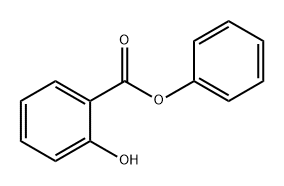
| Description | Phenyl salicylate (chemical formula: C13H10O3) belongs to the family
of hydroxybenzoic acid which are compound containing a
hydroxybenzoic acid or its derivative. It is manufactured through
the chemical reaction between phenol and salicylic acid. Phenyl
salicylate has several medical properties. It can be used as
analgesic to relieve pain, as an antiseptic with antibacterial
effect as well as a kind of antipyretic for the treatment of fever.
It is also used for the treatment of inflammation triggered by the
lower urinary tract. However, it is no longer commonly applied to
human medicine, but is still used in veterinary medicine. | | References | https://pubchem.ncbi.nlm.nih.gov/compound/Phenyl_salicylate#section=Top
http://www.wisegeek.com/what-are-the-medical-uses-of-phenyl-salicylate.htm
| | Chemical Properties | Phenyl salicylate is a white crystalline solid with a distinctive aromatic odor and taste. Soluble in ether, benzene and chloroform, soluble in ethanol, almost insoluble in water and glycerol. | | Uses | Phenyl salicylate is used as an analgesic and antipyretic. It is also used in the manufacture of polymer plastics, lacquers, waxes, polishes, adhesives, and sunscreen products(suntan oils and cremes). As light absorber to prevent discoloration of plastics. It is also a fragrance ingredient, but has limited use. in veterinary use as an external disinfectant and intestinal antiseptic agent. | | Definition | ChEBI: Phenyl salicylate is a benzoate ester that is the phenyl ester of salicylic acid. Also known as salol, it can be formed by heating salicylic acid with phenol and is used in the manufacture of some polymers, lacquers, adhesives, waxes and polishes. It has a role as an ultraviolet filter. It is a benzoate ester, a member of phenols and a member of salicylates. It derives from a salicylic acid. | | Preparation | Phenyl salicylate was synthesized by esterification of salicylic acid and phenol in the presence of catalyst sulfuric acid. The esterification liquid is neutralized, washed with water and distilled to obtain the finished product. It also can preparation by the action of phosphorus oxychloride on a mixture of phenol and salicylic acid (Merck Index, 1968). | | Toxicity evaluation | The acute oral LD50 value in rats was reported as 3 g/kg and the acute dermal LD50 value in rabbits exceeded 5 g/kg (Levenstein, 1975). The probable LD in man is 50-500 mg/kg. The toxic effects of phenyl salicylate are similar to those of phenol but do not include a corrosive action on the alimentary canal (Dittmer, 1959). | | General Description | White crystals. Insoluble in water. | | Air & Water Reactions | Insoluble in water. | | Reactivity Profile | Incompatible with bromine water, ferric salts, camphor, phenol, chloral hydrate, monobrominated camphor, thymol, or urethane in trituration. . | | Fire Hazard | Flash point data for Phenyl salicylate are not available, however Phenyl salicylate is probably combustible. | | Pharmacology | Phenyl salicylate was found to have slight analgesic activity against pain stimuli
in mice (Kameyama, 1961), but ip administration of 500 mg/kg showed no analgesic action against
an electric shock applied to the tails of mice (McKenzie & Beechey, 1962). In vitro studies on
cartilage and rat-liver mitochondria have shown that phenyl salicylates are more active than salicylates
in uncoupling oxidative phosphorylation (Bostrom, Berntsen & Whitehouse, 1964). | | Safety Profile | Moderately toxic by ingestion. Experimental teratogenic and reproductive effects. When heated to decomposition it emits acrid smoke and irritating fumes. See also ESTERS | | Metabolism | According to Baas (1890) from 44 to 96% of a dose (5-8 g) of phenyl salicylate is hydrolysed in man and none of it is found in the faeces. An increase in the ethereal sulphates of the urine after its ingestion is due, no doubt, to the phenol liberated (Williams, 1959). Phenyl salicylate is hydrolysed in the gut primarily to phenol and salicylic acid, which are rapidly absorbed and excreted (Fassett, 1963), but it was not hydrolysed by a partially purified preparation of acetylarylesterase from human plasma (Augustinsson & Ekedahl, 1962). Intestinal absorption and excretion of orally administered phenyl salicylate were studied in rabbits and dogs by analysis of blood and urine samples; oral administration of glucosamine hydrochloride increased the blood concentration of phenyl salicylate but had little effect on urinary excretion (Tanaka, Kojima & Matsubara, 1961). | | Purification Methods | Fractionally crystallise salol from its melt, then crystallise it from *benzene. [Beilstein 10 IV 154.] |
| Phenyl salicylate Preparation Products And Raw materials |
|


 日本语
日本语 한국어
한국어 Français
 Deutsch
 España
 Türkiye