Other grades of this product :
| Scopolamine hydrobromide Basic information |
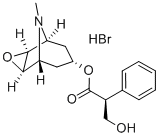
| Product Name: | Scopolamine hydrobromide | | Synonyms: | Benzeneacetic acid, a-(hydroxyMethyl)-, (1a,2b,4b,5a,7b)-9-Methyl-3-oxa-9-azatricyclo[3.3.1.02,4]non-7-ylester, hydrobroMide (1:1), (aS)-;ScopolaMine HBr Trihydrate;ScopolaMine-d3 HBr 3H2O;Hyosol;Tranaxine;Benzeneacetic acid, α-(hydroxymethyl)-, (1α,2β,4β,5α,7β)-9-methyl-3-oxa-9-azatricyclo[3.3.1.02,4]non-7-yl ester, hydrobromide (1:1), (αS)-;Hyoscine HydrobroMide Trihydrate, (1α,2β,4β,5α,7β)-9-Methyl-3-oxa-9-azatricyclo[3.3.1.02,4]non-7-yl Ester HydrobroMide Trihydrate;SCOPOLAMINE HBR | | CAS: | 114-49-8 | | MF: | C17H21NO4.BrH | | MW: | 384.26 | | EINECS: | 204-050-6 | | Product Categories: | chemical reagent;pharmaceutical intermediate;API;phytochemical;reference standards from Chinese medicinal herbs (TCM).;standardized herbal extract;Alkaloids;Aromatics;Heterocycles;Intermediates & Fine Chemicals;Pharmaceuticals;Isotope Labeled Compounds;Acetylcholine receptor;Inhibitors | | Mol File: | 114-49-8.mol |
| Scopolamine hydrobromide Chemical Properties |
| Hazard Codes | Xn | | Risk Statements | 22 | | Safety Statements | 36 | | RIDADR | UN 1544 6.1/PG 1 | | WGK Germany | 3 | | RTECS | YM4550000 | | F | 3-8 | | HS Code | 2939800000 | | Toxicity | LD50 in rats (mg/kg): 3800 s.c. (Stockhaus, Wick) |
| Scopolamine hydrobromide Usage And Synthesis |
| Description | Scopolamine is a tropane alkaloid that can be found in many plants of the Solanaceae (nightshade) family. It is a muscarinic receptor antagonist that can be used to induce memory impairment in animals. Scopolamine prevents motion sickness, nausea, and vomiting in animals. | | Chemical Properties | Off-White Solid | | Uses | An acetylcholine antagonist. Used in treatment of motion sickness; antiemetic; antispasmodic; mydriatic; preanesthetic medicant | | Definition | ChEBI: A hydrobromide that is obtained by reaction of scopolamine with hydrogen bromide. | | Brand name | Isopto Hyoscine (Alcon); Transderm-Scop (Ciba-Geigy). | | General Description | Scopolamine hydrobromide(hyoscine hydrobromide) occurs as white orcolorless crystals or as a white, granular powder. It is odorlessand tends to effloresce in dry air. It is freely soluble inwater (1:1.5), soluble in alcohol (1:20), only slightly solublein chloroform, and insoluble in ether.Scopolamine is a competitive blocking agent of theparasympathetic nervous system as is atropine, but it differsmarkedly from atropine in its action on the higher nervecenters. Both drugs readily cross the blood-brain barrierand, even at therapeutic doses, cause confusion, particularlyin the elderly. | | General Description | Colorless crystals or white powder or solid. Has no odor. pH (of 5% solution): 4-5.5. Slightly efflorescent in dry air. Bitter, acrid taste. | | Air & Water Reactions | Sensitive to air, light and moisture. Water soluble. | | Reactivity Profile | Scopolamine hydrobromide is incompatible with acids, bases and oxidizing agents. . | | Fire Hazard | Flash point data for Scopolamine hydrobromide are not available; however, Scopolamine hydrobromide is probably combustible. | | Biological Activity | Non-selective muscarinic antagonist. Widely used clinically to treat motion sickness. | | Clinical Use | A sufficiently large dose of scopolamine will cause an individualto sink into a restful, dreamless sleep for about8 hours, followed by a period of approximately the samelength in which the patient is in a semiconscious state.During this time, the patient does not remember events thattake place. When scopolamine is administered with morphine,this temporary amnesia is termed twilight sleep. | | Drug interactions | Potentially hazardous interactions with other drugs
None known | | Metabolism | Hyoscine hydrobromide is almost entirely metabolised,
probably in the liver; only a small proportion of an oral
dose is excreted unchanged in the urine. In one study in
man, 3.4% of a single dose, administered by subcutaneous
injection was excreted unchanged in urine within 72
hours. | | Purification Methods | The hydrobromide is recrystallised from Me2CO, H2O or EtOH/Et2O and dried. It is soluble in H2O (60%) and EtOH (5%) but insoluble in Et2O and slightly in CHCl3. The hydrochloride has m 300o (from Me2CO). The free base is a viscous liquid which forms a crystalline hydrate with m 59o and [] D 20 -28o (c 2.7, H2O). It hydrolyses in dilute acid or base. [Meinwald J Chem Soc 712 1953, Fodor Tetrahedron 1 86 1957, Beilstein 6 III 4185.] |
| Scopolamine hydrobromide Preparation Products And Raw materials |
|


 日本语
日本语 한국어
한국어 Français
 Deutsch
 España
 Türkiye