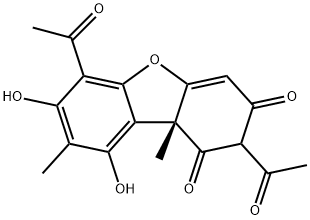
| (+)-Usniacin Basic information |
| Preparation |
| Product Name: | (+)-Usniacin |
| Synonyms: | D-2,6-DIACETYL-7,9-DIHYDROXY-8,9BETA-DIMETHYL-1,3[2H,9BH]-DIBENZOFURANDIONE;D-USNIC ACID;TIMTEC-BB SBB006458;(+)-USNEIN;(+)-USNIACIN;(r)-usnicaci;3(2h,9bh)-dibenzofurandione,2,6-diacetyl-7,9-dihydroxy-8,9b-dimethyl-(9b;6-diacetyl-1,7,9-trihydroxy-8,9b-dimethyl-d-3(9bh)-dibenzofuranon |
| CAS: | 7562-61-0 |
| MF: | C18H16O7 |
| MW: | 344.32 |
| EINECS: | 231-456-0 |
| Product Categories: | Inhibitors;Pharmaceutical Raw Materials;Plant Oils, Toxins, Phenolic Acids & Derivatives |
| Mol File: | 7562-61-0.mol |
| (+)-Usniacin Chemical Properties |
| Melting point | 201-203 °C(lit.) |
| alpha | 488 º (c=0.4, CHCl3) |
| Boiling point | 399.43°C (rough estimate) |
| density | 1.2869 (rough estimate) |
| refractive index | 1.4790 (estimate) |
| storage temp. | Sealed in dry,Room Temperature |
| solubility | almost transparency in Chloroform |
| form | powder to crystal |
| pka | 4.00±0.40(Predicted) |
| color | Light orange to Yellow to Green |
| optical activity | [α]25/D +488°, c = 0.7% in chloroform |
| Water Solubility | Partly soluble in water. Soluble in acetone, ethanol, chloroform and furfural. |
| Merck | 14,9893 |
| BRN | 96698 |
| CAS DataBase Reference | 7562-61-0(CAS DataBase Reference) |
| Safety Information |
| Hazard Codes | Xn |
| Risk Statements | 22 |
| Safety Statements | 36 |
| WGK Germany | 3 |
| RTECS | HP5295050 |
| F | 3-10 |
| HazardClass | IRRITANT |
| HS Code | 29329990 |
| MSDS Information |
| Provider | Language |
|---|---|
| SigmaAldrich | English |
| (+)-Usniacin Usage And Synthesis |
| Preparation | Weigh 5.0 g of chopped Usnea longiflora into a 500 mL flask, and extract with 75 mL of ethyl acetate for 2 times, 4 h each time, and combine the extracts. Suction filtration, concentrated to 1/6~1/8 of the original volume, naturally cooled, crystallized, filtered off the mother liquor, and dried at 80°C to obtain the crude usnic acid. 30 times the amount of benzene-ethanol (volume ratio 1:1) mixed solvent was added to the crude product, refluxed for 2 h, filtered while hot, the filtrate was concentrated to 1/5 of the original volume, and crystals were precipitated by cooling. Dry at 80 ℃, recrystallize twice with ethyl acetate, and the obtained relatively pure pale yellow needle crystal is the fine usnic acid. |
| Uses | Usnic acid is used as fragrance; preservative in deodorants; in anti ac ne formulations; antibiotic for topical application. |
| Uses | Usnic Acid acts as an antibacterial and antifungal agent, and are often seen used in cosmetics and facial application chemicals. |
| Uses | (+)-Usnic acid has been used to study the following:
|
| General Description | (+)-Usniacin is a primary reference substance with assigned absolute purity (considering chromatographic purity, water, residual solvents, inorganic impurities). The exact value can be found on the certificate. Produced by PhytoLab GmbH & Co. KG. |
| Biological Activity | mic: 0.05 μg/62.5 μl to 3.1 μg/62.5 μlmicroorganisms can colonize a wide variety of medical devices, putting patients at risk for systemic and local infectious complications, including local-site infections, endocarditis, and catheter-related bloodstream infections. (+)-usniacin is a secondary lichen metabolite that possesses antimicrobial activity against various planktonic gram-positive bacteria. |
| Contact allergens | Usnic acid is a component of lichens, also used as a topical antibiotic. Allergic contact dermatitis from lichens occurs mainly occupationally in forestry and horticultural workers, and in lichen pickers. |
| in vitro | (+)-usniacin showed antimicrobial activity against the same microorganisms as that of acetone extract. among the three analogues it was the most active one having quite low mic values. furthermore, (+)-usniacin did not show any activity against a. hydrophila and b. cereus whereas (d)-usnic acid did. on the other hand, (+)-usniacin was active against y. enterocolitica whereas (d)-usnic acid was not active [1]. |
| Purification Methods | This very weak acid is the natural form which is recrystallised from Me2CO, MeOH or *C6H6. At 25o it is soluble in H2O (<0.01%), Me2CO (0.77%), EtOAc (0.88%), MeOCH2CH2OH (0.22%) and furfural (7.32%). [Curd & Robertson J Chem Soc 894 1937, Barton & Brunn J Chem Soc 603 1953, resolution: Dean et al. J Chem Soc 1250 1953, synthesis: Barton et al. J Chem Soc 538 1956, Beilstein 18/5 V 586.] |
| references | [1] tay t, türk ao, yilmaz m, türk h, kivanç m. evaluation of the antimicrobial activity of the acetone extract of the lichen ramalina farinacea and its (+)-usnic acid, norstictic acid, and protocetraric acid constituents. z naturforsch c. 2004 may-jun;59(5-6):384-8.[2] ghione m, parrello d, grasso l. usnic acid revisited, its activity on oral flora. chemioterapia. 1988 oct;7(5):302-5. |
| (+)-Usniacin Preparation Products And Raw materials |
Please leave a message for us or use the following ways to contact us, we will reply to you as soon as possible, and provide you with the most sincere service, thank you.

 日本语
日本语 한국어
한국어 Français
 Deutsch
 España
 Türkiye