Other grades of this product :
| PD 173074 Basic information |
| PD 173074 Chemical Properties |
| Melting point | 82-85°C | | density | 1.163 | | storage temp. | 2-8°C | | solubility | DMSO: 21 mg/mL | | form | solid | | pka | 10.12±0.43(Predicted) | | color | yellow | | Stability: | Stable for 1 year from date of purchase as supplied. Solutions in DMSO may be stored at -20° for up to 3 months. |
| Hazard Codes | Xi | | Risk Statements | 36/37/38 | | Safety Statements | 26 | | WGK Germany | 3 | | HS Code | 2933599590 |
| PD 173074 Usage And Synthesis |
| Description | PD173074 (219580-11-7) is an inhibitor of FGFR tyrosine kinase, and to a lesser extent VEGFR1?(IC50?values are 5 nM, 22.5 nM and 100 nM for FGFR1, FGFR3 and VEGFR respectively). Inhibition of FGFR by PD173074 promotes stem cell self renewal.2,3 | | Chemical Properties | Yellow Solid | | Uses | PD173074 is a potent FGFR1 inhibitor with IC50 of ~25 nM and also inhibits VEGFR2 with IC50 of 100-200 nM. | | Uses | PD 173074
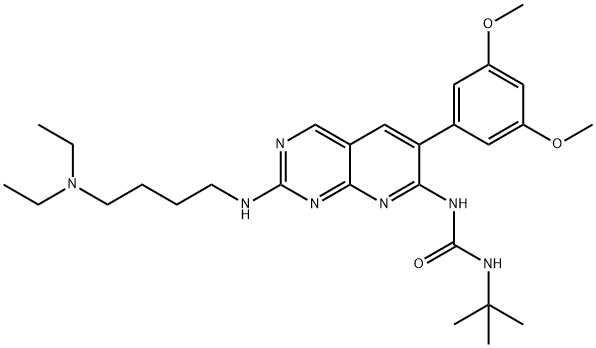
ar signal-related kinase phosphorylation. | | Uses | A selective FGFR1 and | | Definition | ChEBI: A member of the class of ureas that is 1-tert-butylurea in which one of the hydrogens attached to N3 is substituted by a pyrido[2,3-d]pyrimidin-7-yl group, which is itself substituted at pos
tions 2 and 6 by a 4-(diethylamino)butyl]amino group and a 3,5-dimethoxyphenyl group, respectively. It is a FGF/VEGF receptor tyrosine kinase inhibitor. | | Biological Activity | Selective FGFR1 and FGFR3 inhibitor (IC 50 values are 5, 21.5, ~100, 17600 and 19800 nM for FGFR3, FGFR1, VEGFR2, PDGFR and c-Src respectively, and > 50000 nM for EGFR, InsR, MEK and PKC). Inhibits VEGF- and FGF-induced angiogenesis in the mouse cornea model of angiogenesis. Inhibits proliferation and differentiation of oligodendrocyte progenitors. | | Biochem/physiol Actions | PD 173074 is a fibroblast growth factor receptor 3 (FGFR3) inhibitor: IC50 = 5 nM inhibition of FGFR3 autophosphorylation. PD 173074 arrests the G0/G1 phase of FGFR3-expressing cells. It is 100-fold more selective for FGFR3 than for VEGF receptors, IGF-1 receptors, and MAPKs. | | in vitro | pd173074 was found to block h-510 and h-69 sclc proliferation and clonogenic growth in a dose-dependent fashion and prevent fgf-2-induced chemoresistance as well. these effects correlate with the inhibition of both fgfr1 and fgfr2 transphosphorylation. in addition, pd173074 showed a high degree of selectivity for fgfr tyrosine kinase [2]. | | in vivo | in the h-510 xenograft mouse model, tumor growth was significanlty improved similar to that seen with single-agent cisplatin administration. accordingly, pd173074 treatment resulted in significanlty prolonged median survival when compared with that of control sham-treated animals. more dramatically, pd173074 also induced complete responses lasting >6 months in 50% of in mice h-69 xenografts [2]. | | References | 1 Bansal?et al. (2003),?Specific inhibitor of FGF receptor signaling: FGF-2 mediated effects on proliferation, differentiation and MAPK activation are inhibited by PD173074 in oligodendrocyte-lineage cells; J. Neurosci. Res.,?74?486
2) Kim?et al. (2012),?Regulation of autocrine fibroblast growth factor-2 signaling by perfusion flow in 3D human mesenchymal stem cell constructs; Biotechnol. Prog.,?28?1384
3) Zaragosi?et al. (2006),?Autocrine fibroblast growth factor 2 signaling is critical for self renewal of human multipotent adipose-derived stem cells; Stem Cells,?24?2412 |
| PD 173074 Preparation Products And Raw materials |
|


 日本语
 한국어
 Français
 Deutsch
 España
 Türkiye