Other grades of this product :
| Diafenthiuron Basic information |
| Diafenthiuron Chemical Properties |
| Melting point | 144.6-147.7°C | | Boiling point | 448.8±55.0 °C(Predicted) | | density | 1.0367 (rough estimate) | | refractive index | 1.5950 (estimate) | | Fp | 149 °C | | storage temp. | 0-6°C | | solubility | Chloroform (Slightly), Methanol (Slightly) | | pka | 12?+-.0.70(Predicted) | | form | neat | | color | White to Off-White | | Merck | 13,2988 | | BRN | 8343025 | | CAS DataBase Reference | 80060-09-9(CAS DataBase Reference) | | EPA Substance Registry System | Diafenthiuron (80060-09-9) |
| Hazard Codes | Xn | | Risk Statements | 20 | | Safety Statements | 22 | | RIDADR | UN 2811 | | WGK Germany | 2 | | RTECS | XN9100000 | | HazardClass | 6.1(a) | | PackingGroup | II | | HS Code | 29309090 | | Toxicity | LD50 in rats (mg/kg): 2068 orally; >2000 dermally; LC50 (14 hr) in rats: 558 mg/m3 by inhalation (Streibert, 1988) |
| Diafenthiuron Usage And Synthesis |
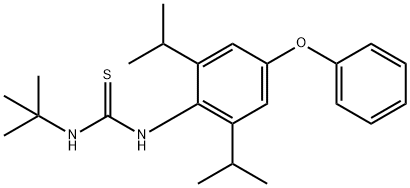
| Description | Diafenthiuron is a broad spectrum acaricide and insecticide, diafenthiuron is registered for use on cotton, soybeans, vegetables, fruit and ornamentals. It controls all post-hatch stages of mites, whiteflies and aphids. Its ability to control all sucking pests of cotton as well as mites, with no known toxicity to beneficial insects, is unique and very valuable in cotton integrated pest management (IPM) programs. | | Uses | Diafenthiuron is an insecticide. | | Toxicology | Diafenthiuron has low toxicity to birds, mammals and beneficial insects, and is only slightly toxic to predatory mites. It is toxic to fish, but presents little hazard because it is rapidly degraded. | | Mode of action | Diafenthiuron is a proinsecticide, which means that it must be converted to another compound – the drug – in order to be toxic. Activation of diafenthiuron to its carbodiimide drug occurs on the leaf surface, catalyzed by light, or in the insect, catalyzed by P450 monooxygenases. Diafenthiuron carbodiimide binds to the glutamate residue in the transmembrane F0 subunit of ATP synthase where protons from the intermembrane space dock to begin their journey across the inner mitochondrial membrane. Binding of diafenthiuron carbodiimide to this site blocks proton transport and ATP synthesis. Diafenthiuron was launched in 1991 and resistance has not yet been reported. |
| Diafenthiuron Preparation Products And Raw materials |
|


 日本语
日本语 한국어
한국어 Français
 Deutsch
 España
 Türkiye