Other grades of this product :
| TRIFORINE Basic information |
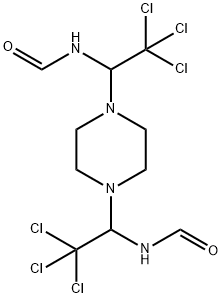
| Product Name: | TRIFORINE | | Synonyms: | SAPROL;SAPROL(R);N,N'-[PIPERAZINE-1,4-DIYLBIS(TRICHLOROMETHYL)METHYLENE]-DIFORMAMIDE;PIPERAZIN-1,4-DIYL-BIS-[1-(2,2,2-TRICHLOROETHYL)FORMAMIDE];TRIFORIN;TRIFORINE;1,4-bis(1-formamido-2,2,2-trichloroethyl)-piperazin;1,4-bis(1-formamido-2,2,2-trichloroethyl)piperazine | | CAS: | 26644-46-2 | | MF: | C10H14Cl6N4O2 | | MW: | 434.96 | | EINECS: | 247-872-0 | | Product Categories: | Amide structureAlphabetic;Fungicides;Pesticides;TP - TZ;Alpha sort;Amide structurePesticides&Metabolites;Q-ZAlphabetic | | Mol File: | 26644-46-2.mol |
| TRIFORINE Chemical Properties |
| Melting point | 155℃ (decomposition) | | Boiling point | 561.5±50.0 °C(Predicted) | | density | 1.5269 (rough estimate) | | vapor pressure | 8 x 10⁻² Pa (25 °C) | | refractive index | 1.6000 (estimate) | | storage temp. | 0-6°C | | solubility | DMSO (Slightly) | | pka | 10.6 (base) | | Water Solubility | 9 mg l-1 (20 °C) | | form | neat | | color | White to Off-White | | Merck | 13,9762 | | BRN | 626358 | | CAS DataBase Reference | 26644-46-2 | | EPA Substance Registry System | Triforine (26644-46-2) |
| TRIFORINE Usage And Synthesis |
| Description | Triforine is a clear light yellow colour with an ethanol (alcohol) odour and a highly flammable
liquid. It is used as a fungicide for the control of black spot, powdery mildew, and
diseases of rust in roses, fruits, vegetables, cereals, and ornamentals. Application of triforine
acts both as a preventative and a curative fungicide and is known to destroying
diseases already in the plant and also preventing disease infestations. It is also used as
a post-harvest control of brown rot on peaches, nectarines, apricots, cherries, and plums. | | Uses | food additive; fungicide; agricultural chemical. | | Uses | Triforine is used to control powdery mildews on cereals, fruits,
vines, hops, ornamentals, cucurbits and some vegetables, rusts on cereals,
fruit, ornamentals and beans. It also controls Munilia spp. on stone
fruit, Ascochyta blight on chrysanthemums, black spot on roses, scab
on apples and fairy rings on turf. Triforine also suppresses tetranychid
mite activity. | | Uses | This pesticide is widely used in flower growing. Cross
reactions are expected to diehlorvos. | | Definition | ChEBI: A member of the class of N-alkylpiperazines in which the two amino groups of piperazine are replaced by 1-formamido-2,2,2-trichloroethyl groups. A fungicide active against a range of diseases including powdery mildew, scab and rust. | | General Description | Colorless crystals. Non corrosive. Used as a fungicide. | | Reactivity Profile | A piperazine, trichloromethylformamide derivative. Decomposed in strong acid to trichloroacetaldehyde and piperazine salts, and in strongly alkaline media to chloroform and piperazine. | | Hazard | Low toxicity by ingestion, inhalation, and
skin contact. Human systemic effects. | | Agricultural Uses | Fungicide: Triforine is a systemic fungicide with protectant,
eridicant, and curative activity. It is locally systemic, is
quickly absorbed by the plant and should be applied on or
before an infection occurs. Triforine is used for control of
black spot, brown rot, scab, petal blight, rust and other diseases on fruits such as apples, peaches, plumbs, nectarines,
apricots, and strawberry; in hops, vegetables, cereals, and
ornamentals such as roses and chrysanthemums. Triforine
breaks down rapidly in the environment. Not approved for
use in EU countries
. Registered for use in the U.S. | | Trade name | CELA50®; CW524®; DENARIN®
FUNGINEX®; SAPROL®; TRIFORIN®; W524® | | Contact allergens | This pesticide is widely used in flower growing. Cross-
reactions are expected to dichlorvos. | | Safety Profile | Low toxicity by
ingestion, inhalation, and skin contact.
Human systemic effects: change in taste
function. When heated to decomposition
emits toxic fumes of NOx and Cl-. | | Metabolic pathway | Thermal reaction of triforine with several alcohols in a
closed glass tube gives N-(1-alkoxy-2,2,2-
trichloroethyl) formamides. | | Degradation | Triforine (1) is stable up to 180°C. It decomposes in aqueous solution
when exposed to daylight or UV light. In strongly acid media, it is
decomposed to trichloroacetaldehyde and piperazine salts. In strongly
basic media, triforine decomposes to give chloroform and piperazine
(DT50 3.5 days at pH 5-7, 25 °C). From an unbuffered aqueous solution
stored for 13 weeks, four hydrolysis products of triforine, 5, 6, 7 and 3,
were isolated by preparative thin-layer chromatography. After 6 months
at room temperature in an unbuffered solution, 7 was the major product.
These products indicate that stepwise removal of substituents from the
nitrogen atoms of the ring occurred and the composition of the mixtures
produced by hydrolysis was shown to be pH- and time-dependent
(Scheme 1).
When solid triforine was irradiated with UV light (254 nm) for 1, 16
or 64 hours, analysis of the products showed that one side chain was
removed preferentially and the second was attacked more slowly.
Products 2, 3, 4 [N-(2,2-dichlorovinyl)formamide], 12 (probably formed
by reaction of 2 with chloral, a photoproduct) and 2,2,2-trichloroethane-
1,1-diol were identified and minor amounts of six other products were
detected by thin-layer chromatography. Compound 2 is probably the
major photolytic product. When triforine was irradiated in solution in
deionised water with a quartz high pressure lamp (maximum energy at
366 nm), 4 was isolated and identified as a product of photolysis but was
itself photolabile and could no longer be detected after 5 hours irradiation
(Darda et al., 1977). |
| TRIFORINE Preparation Products And Raw materials |
|


 日本语
 한국어
 Français
 Deutsch
 España
 Türkiye