Other grades of this product :
| D-CAMPHOR Basic information |
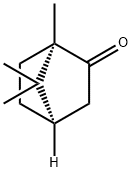
| Product Name: | D-CAMPHOR | | Synonyms: | 7,7-trimethyl-(1r)-bicyclo(2.2.1)heptan-2-on;7,7-trimethyl-(1theta)-bicyclo[2.2.1]heptan-2-on;Bicyclo[2.2.1]heptan-2-one, 1,7,7-trimethyl-, (1R)-;R-(+)-Camphor;D-(+)-Camphor,98%;CAMPHOR FLAKE, USP24;CAMPHOR, (+)-(SG);(1R,4R)-(+)-Camphor | | CAS: | 464-49-3 | | MF: | C10H16O | | MW: | 152.23 | | EINECS: | 207-355-2 | | Product Categories: | Inhibitors;Alphabetical Listings;Bicyclic Monoterpenes;Biochemistry;C-D;Flavors and Fragrances;Food and Feed Additive;Camphor, etc. (Plasticizer);Functional Materials;Plasticizer;Terpenes | | Mol File: | 464-49-3.mol |
| D-CAMPHOR Chemical Properties |
| Melting point | 178-182 °C (lit.) | | Boiling point | 204 °C | | alpha | D25 +41 to +43° (c = 10 in U.S.P. alcohol) according to U.S.P. specif | | density | 0,99 g/cm3 | | vapor density | 5.24 (vs air) | | vapor pressure | 4 mm Hg ( 70 °C) | | refractive index | 44.5 ° (C=20, EtOH) | | FEMA | 2230 | D-CAMPHOR | | Fp | 148 °F | | storage temp. | 2-8°C | | solubility | Slightly soluble in water, very soluble in alcohol and in light petroleum, freely soluble in fatty oils, very slightly soluble in glycerol. | | form | Crystals | | color | White | | explosive limit | 3.5% | | optical activity | [α]25/D +44°, c = 10 in ethanol | | Water Solubility | Soluble in water (0.1 g/L at 20°C). | | Merck | 14,1732 | | JECFA Number | 1395 | | BRN | 2042745 | | Stability: | Stable. Incompatible with strong reducing agents, strong oxidizing agents, chlorinated solvents. Protect from direct sunlight. | | LogP | 2.3 at 20℃ | | CAS DataBase Reference | 464-49-3(CAS DataBase Reference) | | EPA Substance Registry System | D-Camphor (464-49-3) |
| D-CAMPHOR Usage And Synthesis |
| Description | (1R)-(+)-Camphor is a terpene that has been found in C. sativa, C. indica, and C. sativa/C. indica hybrid strains as well as the essential oils from a variety of herbs including rosemary, lavender, and sage and has diverse biological activities. It inhibits norepinephrine secretion and cytosolic calcium and sodium increases induced by the nicotinic acetylcholine receptor (nAChR) agonist 1,1-dimethyl-4-phenylpiperazinium iodide (DMPP) in chromaffin cells (IC50s = 70, 88, and 19 μM, respectively). (1R)-(+)-Camphor (65-260 μM) induces proliferation of and increases expression of collagen IA, collagen IIIA, collagen IVA, and elastin in human primary dermal fibroblasts. In vivo, (1R)-(+)-camphor increases expression of collagen IA, collagen IIIA, collagen IVA, and elastin in skin in UV-exposed mice when administered at doses of 26 and 55 mM in drinking water post UV-exposure. It reduces cough frequency in citric acid-challenged guinea pigs. (1R)-(+)-Camphor is insecticidal, reducing digging activity and inducing mortality of fire ant workers. It has also been used as a building block in the synthesis of cannabinergic ligands. | | Chemical Properties | d-Camphor has a warm, minty, almost ethereal diffusive aroma. For other details of description, see Camphor Tree. | | Chemical Properties | white crystals | | Occurrence | Frequently occurring in nature as the d- or l-form; the optically inactive form is seldom encountered. The
d-form has been reported found in Cinnamomum camphora Ness. (Laurus camphora L.) from China, Japan and the East Indies; in
Sassafras officinale, Lavandula spica and in other Labiatae. The l-form is reported found in the essential oils of Salvia grandiflora,
Matricaria parthenium, Artemisia herba alba; the optically inactive form is found in Chrysanthemum japonicum sinense. Also
reported found in orange peel oil, lemon peel oil, apricot, raspberry, anise, cinnamon root bark, ginger, pepper, coriander, calamus,
sweet fennel and rosemary. | | Uses | (1R)-(+)-Camphor is used as a chiral intermediate and auxiliary. It is also used as a skin antipruritic and as an anti-infective agent. | | Uses | D-Camphor may be used as reference material for the quantification of the analyte in Saraca asoca and coriander using chromatography techniques. | | Uses | (R)-(+)-Camphor is a terpenoid with a wide variety of use. (R)-(+)-Camphor has insecticidal activity and is also used as an antimicrobial agent. (R)-(+)-Camphor is used as a culinary flavouring agent in parts of asia. | | Uses | analgesic, antiinfective, antipruritic | | Definition | ChEBI: The (R)- enantiomer of camphor. | | Aroma threshold values | Detection at 1 to 1.29 ppm | | Taste threshold values | Taste characteristics at 20 ppm: medicinal, camphoraceous, mentholic and woody. | | General Description | Colorless or white crystals. Sublimes. Flash point 149°F. Burns readily with a bright, smoky flame. Penetrating aromatic odor. Pungent, aromatic taste followed by a sensation of cold. | | Air & Water Reactions | Flammable. Insoluble in water. | | Reactivity Profile | D-CAMPHOR is incompatible with strong oxidizing agents, strong reducing agents and chlorinated solvents. | | Fire Hazard | D-CAMPHOR is combustible. | | Flammability and Explosibility | Flammable | | Synthesis | Natural camphor is obtained by distillation from the plants of Cinnamomum or Laurus camphora from China and Japan,
together with the corresponding essential oils; the raw camphor contains several impurities. It is separated from the water and the
essential oil by pressure or by centrifugation and subsequently purified by sublimation or crystallization. Synthetic camphor is prepared
from pinene isolated by fractional distillation of turpentine oil; pinene is reacted to bornyl chloride with gaseous HCl under
pressure and then to camphene. The distilled and purified camphene is then oxidized to camphor with Na+ or K+ bichromate in the
presence of H2SO4. | | Purification Methods | Crystallise it from EtOH, 50% EtOH/water, MeOH, or pet ether or from glacial acetic acid by addition of water. It can be sublimed (50o/14mm) and also fractionally crystallised from its own melt. It is steam volatile. It should be stored in tight containers as it is appreciably volatile at room temperature. The solubility is 0.1% (H2O), 100% (EtOH), 173% (Et2O) and 300% |
| D-CAMPHOR Preparation Products And Raw materials |
|


 日本语
日本语 한국어
한국어 Français
 Deutsch
 España
 Türkiye