Other grades of this product :
| 2-Methylhexane Basic information |
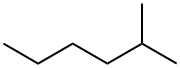
| Product Name: | 2-Methylhexane | | Synonyms: | 2-methyl-hexan;d726;ethylisobutylmethane;hexane,2-methyl-;ISOHEPTANE;Methylhexane;2-Methylhexane, 99% 5ML;NSC-24840 | | CAS: | 591-76-4 | | MF: | C7H16 | | MW: | 100.2 | | EINECS: | 209-730-6 | | Product Categories: | | Mol File: | 591-76-4.mol |
| 2-Methylhexane Chemical Properties |
| Melting point | -118 °C | | Boiling point | 90 °C(lit.) | | density | 0.679 g/mL at 25 °C(lit.) | | vapor pressure | 2.27 psi ( 37.7 °C) | | refractive index | n20/D 1.384(lit.) | | Fp | 25 °F | | storage temp. | Flammables area | | solubility | Soluble in acetone, alcohol, benzene, chloroform, ligroin, and ether (Weast, 1986). Miscible with
liquid aliphatic hydrocarbons. | | form | Liquid | | color | Clear colorless | | explosive limit | ~7% | | Water Solubility | 3.8 mg/L at 23 °C (Coates et al., 1985)
2.54 mg/kg at 25 °C (shake flask-GLC, Price, 1976) | | BRN | 1696856 | | Henry's Law Constant | 0.512 atm?m3/mol at 26.9 °C, 0.311 at 35.0 °C, 0.256 at 45.0 °C (dynamic headspace, Hansen et al., 1995) | | CAS DataBase Reference | 591-76-4(CAS DataBase Reference) | | EPA Substance Registry System | 2-Methylhexane (591-76-4) |
| Hazard Codes | F,Xn,N | | Risk Statements | 11-38-50/53-65-67 | | Safety Statements | 9-16-29-33-60-61-62 | | RIDADR | UN 3295 3/PG 2 | | WGK Germany | 3 | | RTECS | MO3871500 | | Autoignition Temperature | 536 °F | | HazardClass | 3.1 | | PackingGroup | II | | HS Code | 29011000 |
| 2-Methylhexane Usage And Synthesis |
| Chemical Properties | clear colorless liquid | | Physical properties | Clear, colorless, flammable, watery liquid with an odor similar to pentane, 2-methylpentane, 3-
methylpentane, hexane, and 3-hexane. An odor threshold concentration of 420 ppbv was reported
by Nagata and Takeuchi (1990). | | Uses | 2-Methylhexane is mainly used as a model iso-alkane in studies relating to iso-alkane oxidation, vapor-liquid phase equilibria of heptane isomers and catalytic cracking. | | Uses | Organic synthesis. | | Hazard | Flammable, dangerous fire risk, explosivelimits in air 1–6%. | | Source | Schauer et al. (1999) reported 2-methylhexane in a diesel-powered medium-duty truck
exhaust at an emission rate of 570 μg/km.
Schauer et al. (2001) measured organic compound emission rates for volatile organic
compounds, gas-phase semi-volatile organic compounds, and particle-phase organic compounds
from the residential (fireplace) combustion of pine, oak, and eucalyptus. The gas-phase emission
rate of 2-methylhexane was 2.6 mg/kg of pine burned. Emission rates of 2-methylhexane were not
measured during the combustion of oak and eucalyptus.
California Phase II reformulated gasoline contained 2-methylhexane at a concentration of 15.3
g/kg. Gas-phase tailpipe emission rates from gasoline-powered automobiles with and without
catalytic converters were 2.88 and 372 mg/km, respectively (Schauer et al., 2002). | | Environmental fate | Biological. Riser-Roberts (1992) reported 2- and 5-methylhexanoic acids as metabolites by the
microorganism Pseudomonas aeruginosa.
Photolytic. Based on a reported photooxidation reaction rate constant of 6.80 x 10⁻¹²
cm3/molecule?sec with OH radicals, the half-life of 2-methylhexane is 25 h (Altshuller, 1990).
Chemical/Physical. Complete combustion in air produces carbon dioxide and water vapor. 2-
Methylhexane will not hydrolyze because it does not contain a hydrolyzable functional group. | | Purification Methods | Purify it by azeotropic distillation with MeOH, then wash it with water (to remove the MeOH), dry it over type 4A molecular sieves and distil it. [Beilstein 1 IV 397.] |
| 2-Methylhexane Preparation Products And Raw materials |
|


 日本语
日本语 한국어
한국어 Français
 Deutsch
 España
 Türkiye