Other grades of this product :
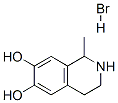
| 6,7-DIHYDROXY-1-METHYL-1,2,3,4-TETRAHYDROISOQUINOLINE HYDROBROMIDE Basic information |
| Product Name: | 6,7-DIHYDROXY-1-METHYL-1,2,3,4-TETRAHYDROISOQUINOLINE HYDROBROMIDE | | Synonyms: | (+/-)-SALSOLINOL, HYDROBROMIDE;1,2,3,4-TETRAHYDRO-1-METHYL-6,7-ISOQUINOLINEDIOL HYDROBROMIDE;1-METHYL-6,7-DIHYDROXY-1,2,3,4-TETRAHYDROISOQUINOLINE;1-METHYL-6,7-DIHYDROXY-1,2,3,4-TETRAHYDROISOQUINOLINE HYDROBROMIDE;6,7-DIHYDROXY-1-METHYL-1,2,3,4-TETRAHYDROISOQUINOLINE HYDROBROMIDE;1,2,3,4-Tetrahydro-1-methyl-6,7-Isoquinolinediol;6,7-DIHYDROXY-1-METHYL-1,2,3,4-TETRAHYDROISOQUINOLINE HYDROBROMIDE 98%;1-methyl-6,7-dihydroxy-1,2,3,4-tetrahydroisoquinoline HBr | | CAS: | 59709-57-8 | | MF: | C10H14BrNO2 | | MW: | 260.13 | | EINECS: | | Product Categories: | Building Blocks;Chemical Synthesis;Aromatics;Neurochemicals;Heterocyclic Building Blocks;Isoquinolines | | Mol File: | 59709-57-8.mol |
| 6,7-DIHYDROXY-1-METHYL-1,2,3,4-TETRAHYDROISOQUINOLINE HYDROBROMIDE Chemical Properties |
| Melting point | 186-187 °C(lit.) | | storage temp. | 2-8°C | | solubility | H2O: soluble5mg/mL (warmed; clear solution) | | form | powder | | color | white to brown | | Stability: | Store in freezer at -20°C |
| Hazard Codes | Xn | | Risk Statements | 36/37/38 | | Safety Statements | 26-36 | | WGK Germany | 3 | | HS Code | 29334990 |
| 6,7-DIHYDROXY-1-METHYL-1,2,3,4-TETRAHYDROISOQUINOLINE HYDROBROMIDE Usage And Synthesis |
| Chemical Properties | Off-White Powder | | Uses | Salsolinol is derived from the neurotransmitter dopamine and acetaldehyde. Interest in this molecule comes from studies suggesting that it might be involved in alcohol addiction, as acetaldehyde is both a well recognized substrate for the Pictet-Spengler reaction and the primary metabolite of ethanol in the liver. It has further been suggested that acetaldehyde formed as a result of alcohol consumption might induce central changes in the metabolism of dopamine. | | Uses | Salsolinol is derived from the neurotransmitter dopamine and acetaldehyde. Interest in this molecule comes from studies suggesting that it might be involved in alcohol addiction, as acetaldehyde is both a well recognized substrate for the Pictet-Spengler reaction and the primary metabolite of ethanol in the liver. It has further been suggested that acetaldehyde formed as a result of alcohol consumption might induce central changes in the metabolism of dopamine. | | General Description | Salsolinol (6,7-dihydroxy-1-methyl-1,2,3,4-tetrahydroisoquinoline) is present in various edibles. It is available as?R?and?S?enantiomers. R-salsolinol in predominantly found in the brain tissue of humans. | | Biochem/physiol Actions | Salsolinol, a neurotoxin, can serve as a prolactin-releasing factor and an etiological factor in the tuberoinfundibular pathway and in Parkinson′s disease (PD), respectively. It can also act as a modulator of catecholaminergic neurotransmission in the nigrostriatal pathway. In central nervous system, salsolinol can change the role of dopaminergic neurons and dopamine metabolism. |
| 6,7-DIHYDROXY-1-METHYL-1,2,3,4-TETRAHYDROISOQUINOLINE HYDROBROMIDE Preparation Products And Raw materials |
|


 日本语
日本语 한국어
한국어 Français
 Deutsch
 España
 Türkiye