Other grades of this product :
| 1,8-Dihydroxy-4,5-dinitroanthraquinone Basic information |
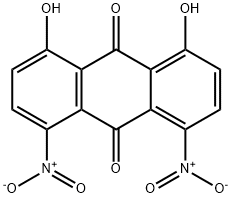
| Product Name: | 1,8-Dihydroxy-4,5-dinitroanthraquinone | | Synonyms: | 4,5 DINITROCHRYSAZINE;1,8-DINITRO-4,5-DIHYDROXYANTHRAQUINONE;1,8-DIHYDROXY-4,5-DINITRO-9,10-ANTHRAQUINONE;1,8-DIHYDROXY-4,5-DINITROANTHRACENE-9,10-DIONE;1,8-DIHYDROXY-4,5-DINITROANTHRAQUINONE;1,8 DIHYDROXY 4,5 DINITRO AQ;TIMTEC-BB SBB006491;4,5’-Dinitrocyrazine | | CAS: | 81-55-0 | | MF: | C14H6N2O8 | | MW: | 330.21 | | EINECS: | 201-360-3 | | Product Categories: | Intermediates of Dyes and Pigments;Anthraquinones, Hydroquinones and Quinones;Anthraquinones;Hydroxyanthraquinones;C13 to C14;Carbonyl Compounds;Ketones | | Mol File: | 81-55-0.mol |
| 1,8-Dihydroxy-4,5-dinitroanthraquinone Chemical Properties |
| Hazard Codes | Xi | | Risk Statements | 36/37/38 | | Safety Statements | 26-36 | | WGK Germany | 3 | | RTECS | CB6700000 | | TSCA | Yes | | HS Code | 29147000 |
| 1,8-Dihydroxy-4,5-dinitroanthraquinone Usage And Synthesis |
| Chemical Properties | brownish-gold solid | | Uses | 1,8-Dihydroxy-4,5-dinitro-9,10-anthracenedione is a NS2B-NS3 protease specific inhibitor that is used for treatment of Dengue and West Nile virus infections. | | General Description | Brownish gold solid. | | Air & Water Reactions | The neat (pure) material is sensitive to air and may be sensitive to light. . Insoluble in water. | | Reactivity Profile | A nitrated alcohol and a ketone. Flammable and/or toxic gases are generated by the combination of alcohols with alkali metals, nitrides, and strong reducing agents. They react with oxoacids and carboxylic acids to form esters plus water. Oxidizing agents convert them to aldehydes or ketones. Alcohols exhibit both weak acid and weak base behavior. They may initiate the polymerization of isocyanates and epoxides. Ketones are reactive with many acids and bases liberating heat and flammable gases (e.g., H2). The amount of heat may be sufficient to start a fire in the unreacted portion of the ketone. Ketones react with reducing agents such as hydrides, alkali metals, and nitrides to produce flammable gas (H2) and heat. Ketones are incompatible with isocyanates, aldehydes, cyanides, peroxides, and anhydrides. They react violently with aldehydes, HNO3, HNO3 + H2O2, and HClO4. | | Fire Hazard | Flash point data for 1,8-Dihydroxy-4,5-dinitroanthraquinone are not available, however, 1,8-Dihydroxy-4,5-dinitroanthraquinone is probably combustible. |
| 1,8-Dihydroxy-4,5-dinitroanthraquinone Preparation Products And Raw materials |
|


 日本语
日本语 한국어
한국어 Français
 Deutsch
 España
 Türkiye