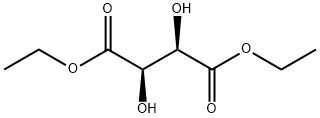
| L(+)-Diethyl L-tartrate Basic information |
| Product Name: | L(+)-Diethyl L-tartrate |
| Synonyms: | (+)-DIETHYL L-TARTRATE;DIETHYL L-(+)-TARTRATE;DIETHYL L-TARTRATE;DIETHYL-L-TARTRATE, (+)-;DIETHYL TARTRATE;(+)-DIETHYL-2,3-DIHYDROXYSUCCINATE;(+)-DIETHYL1-2,3-DIHYDROXYSUCCINATE;DET |
| CAS: | 87-91-2 |
| MF: | C8H14O6 |
| MW: | 206.19 |
| EINECS: | 201-783-3 |
| Product Categories: | Chiral Compound;Asymmetric Synthesis;Chiral Building Blocks;Esters (Chiral);Synthetic Organic Chemistry;CHIRAL CHEMICALS;Pharmaceutical Intermediates;Chiral Compounds;chiral;Hydroxy Acids & Deriv.;bc0001 |
| Mol File: | 87-91-2.mol |
| L(+)-Diethyl L-tartrate Chemical Properties |
| Melting point | 17 °C |
| Boiling point | 280 °C (lit.) |
| alpha | 7.5 º (neat) |
| density | 1.204 g/mL at 25 °C (lit.) |
| vapor pressure | 0.402Pa at 25℃ |
| refractive index | n |
| FEMA | 2378 | DIETHYL TARTRATE |
| Fp | 200 °F |
| storage temp. | Sealed in dry,Room Temperature |
| solubility | Chloroform (Slightly), Water (Slightly) |
| pKa | 11.61±0.20(Predicted) |
| form | Viscous Liquid |
| color | Clear |
| optical activity | [α]20/D +8.5°, neat |
| Water Solubility | insoluble |
| JECFA Number | 622 |
| Merck | 14,3855 |
| BRN | 1727145 |
| InChIKey | YSAVZVORKRDODB-PHDIDXHHSA-N |
| LogP | 0.2 at 25℃ |
| CAS DataBase Reference | 87-91-2(CAS DataBase Reference) |
| NIST Chemistry Reference | Diethyl tartrate(87-91-2) |
| EPA Substance Registry System | Butanedioic acid, 2,3-dihydroxy- (2R,3R)-, 1,4-diethyl ester (87-91-2) |
| Safety Information |
| Hazard Codes | Xi |
| Risk Statements | 36/37/38 |
| Safety Statements | 24/25-36-26 |
| WGK Germany | 3 |
| TSCA | Yes |
| HS Code | 29181300 |
| MSDS Information |
| Provider | Language |
|---|---|
| (2R,3R)(+)-Dihydroxybutane-1,4-dioic acid diethyl ester | English |
| SigmaAldrich | English |
| ACROS | English |
| ALFA | English |
| L(+)-Diethyl L-tartrate Usage And Synthesis |
| Chemical Properties | Diethyl tartrate has a mild, fruity, wine aroma. |
| Chemical Properties | Colorless to light yellow liqui |
| Occurrence | The d-isomer has not been reported found in nature; the l-isomer and the racemic form are of little importance. Reported found in sherry, white and red wine. |
| Uses | (+)-Diethyl L-tartrate is used as a chiral auxiliary in the Sharpless enantioselective epoxidation of allylic alcohols, for Sharpless-type enantioselective oxidation of sulfides to sulfoxides and as a chiral auxiliary in the enantioselective construction of cyclopropanes from allylic alcohols by an asymmetric Simmons-Smith reaction. It is also used as a chiral reagent in a host of chemical reactions, such as the synthesis of isoquinoline alkaloids and arundic acid, which has been used in acute ischemic stroke therapy. |
| Uses | (+)-Diethyl L-tartrate can be used in the synthesis of biologically active compounds such as (+)-altholactone, (-)-aspicilin, (+)-monomorine I and (+)-(1R,2R,3S,6S)-3,6-di-O-methyl conduritol-E. |
| Uses | Diethyl L-(+)-Tartrate is used as a chiral reagent in a host of chemical reactions, such as the synthesis of isoquinoline alkaloids and arundic acid, which has been used in acute ischemic stroke thera py. |
| General Description | Made from natural tartaric acid |
| Flammability and Explosibility | Nonflammable |
| L(+)-Diethyl L-tartrate Preparation Products And Raw materials |
| Raw materials | D(-)-Tartaric acid-->DL-Tartaric acid |
| Preparation Products | (+)-DIOP-->(R)-(-)-2,2-Dimethyl-1,3-dioxolane-4-methanol-->N,N,N',N'-Tetramethyl-L-tartramide |
Please leave a message for us or use the following ways to contact us, we will reply to you as soon as possible, and provide you with the most sincere service, thank you.


 日本语
日本语 한국어
한국어 Français
 Deutsch
 España
 Türkiye