Other grades of this product :
| Calcium gluconate Chemical Properties |
| Melting point | 195°C | | alpha | 10.2 º (c=1, H2O 22 ºC) | | Boiling point | 400℃[at 101 325 Pa] | | density | 1.677[at 20℃] | | vapor pressure | 0.004Pa at 20℃ | | storage temp. | Inert atmosphere,Room Temperature | | solubility | Sparingly soluble in water, freely soluble in boiling water. | | form | Crystals or Crystalline Powder | | color | White | | PH | pH;6.0~8.0 | | Water Solubility | 3.3 g/100mL | | Hydrolytic Sensitivity | 0: forms stable aqueous solutions | | Merck | 14,1669 | | Stability: | Stable. Incompatible with strong oxidizing agents. | | InChIKey | KYUVBRZSDFBLTH-OSQBQZLYSA-M | | LogP | -5.31 at 20℃ | | CAS DataBase Reference | 299-28-5(CAS DataBase Reference) | | EPA Substance Registry System | D-Gluconic acid, calcium salt (2:1) (299-28-5) |
| Calcium gluconate Usage And Synthesis |
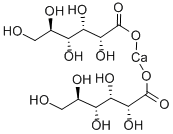
| Description | Calcium gluconate is the calcium salt of gluconate, being an oxidative product of glucose containing 9.3% calcium. Calcium gluconate is a kind of mineral supplement and medication. It can be used for vein injection to treat the low blood calcium, high blood potassium, and magnesium toxicity. It is required only when there is not enough calcium in the diet. It is also used for the treatment of black widow spider bites to relieve muscle cramping and treatment of osteoporosis or rickets. It can also be used to decrease the capillary permeability in allergic conditions, nonthrombocytopenic purpura and exudative dermatoses.
| | References | http://www.drugbank.ca/drugs/DB11126
https://en.wikipedia.org/wiki/Calcium_gluconate
| | Chemical Properties | white crystalline powder or granules | | Uses | analgesic, antipyretic | | Uses | Calcium Gluconate is used as an inert ingredient in pesticide formulations applied to crops. It is also used as a supplement to fortify beverages and foods lacking a sufficient amount of calcium. | | Uses | In sewage purification; in coffee powders to prevent caking. | | Uses | Calcium Gluconate is a white crystalline granule or powder that
functions as a firming agent, formulation aid, sequestrant, and sta-
bilizer. at room temperature the anhydrous form has a solubility of
approximately 1 g in 30 ml of water, which improves in boiling
water to approximately 1 g in 5 ml of water. it also exists as calcium
gluconate (monohydrate). it is used as a source of calcium ions for
sodium alginate gels, and as a calcium fortifier in baked goods, pud-
dings, and dairy product analogs. it functions as a coagulation aid
in milk and instant pudding powders and as a means of masking the
bitter aftertaste of some artificial sweeteners. | | Brand name | Calglucon (Novartis). | | Flammability and Explosibility | Nonflammable | | Industrial uses | calcium gluconate [Ca(C6H11O7)2] is used as a
food additive in vitamin pills.injection of a 10% calcium gluconate has been recommended. It has to be kept
in mind that the plasma Ca2+ level and any changes to the electrocardiogram (ECG) have to be carefully
monitored. | | Clinical Use | Hypocalcaemia | | Safety Profile | Moderately toxic by
subcutaneous, intraperitoneal, and
intravenous routes. Human systemic effects
in infants by intramuscular route: dermatitis
and fever. When heated to decomposition it
emits acrid smoke and fumes. See also
CALCIUM COMPOUNDS. | | Veterinary Drugs and Treatments | Calcium salts are used for the prevention or treatment of hypocalcemic
conditions. | | Drug interactions | Potentially hazardous interactions with other drugs
Can impair absorption of some drugs, e.g. iron,
ciprofloxacin. | | Metabolism | Calcium is absorbed mainly from the small intestine by
active transport and passive diffusion. About one-third
of ingested calcium is absorbed although this can vary
depending upon dietary factors and the state of the small
intestine. 1,25-Dihydroxycholecalciferol (calcitriol), a
metabolite of vitamin D, enhances the active phase of
absorption.
Excess calcium is mainly excreted renally. Unabsorbed
calcium is eliminated in the faeces, together with that
secreted in the bile and pancreatic juice. Minor amounts
are lost in the sweat, skin, hair, and nails. | | Purification Methods | Dissolve it in H2O, filter and precipitate it by adding MeOH. Filter off the solid and dry it in a vacuum at 85o. Alternatively, dissolve it in H2O, filter (from insoluble inorganic Ca) and evaporate it to dryness under vacuum at 85o. [March et al. J Am Pharm Assoc 41 366 1952, Beilstein 3 IV 1255.] |
| Calcium gluconate Preparation Products And Raw materials |
|


 日本语
日本语 한국어
한국어 Français
 Deutsch
 España
 Türkiye