Other grades of this product :
| 1,2-Benzenedicarboxylic acid di-C9-11-branched alkyl esters C10-rich Basic information |
| 1,2-Benzenedicarboxylic acid di-C9-11-branched alkyl esters C10-rich Chemical Properties |
| WGK Germany | 1 | | RTECS | TI1270000 |
| 1,2-Benzenedicarboxylic acid di-C9-11-branched alkyl esters C10-rich Usage And Synthesis |
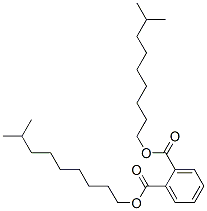
| Chemical Properties | The empirical formula of diisodecyl phthalate (DIDP) is
C28H46O4. The structural formula of DIDP varies because the
iso-alcohols used in the manufacture contain several isomers. DIDPis insoluble in water, but
it is soluble in organic solvents. | | Uses | It is a high-molecular-weight, general-purpose plasticizer
that is added to polyvinyl chloride to impart flexibility. | | Production Methods | DIDP is manufactured by the esterification of phthalic
anhydride with isodecyl alcohol in the presence of a catalyst. | | Definition | ChEBI: Diisodecyl phthalate is a phthalate ester and a diester. Used as plasticizer for polyvinyl chloride in calendered film, coated fabrics, building wire jackets, wire and cable extrusion, and other applications. | | Flammability and Explosibility | Nonflammable | | Carcinogenicity | A 2-year bioassay was conducted
in which DIDP was administered in the diet at
concentrations of 400, 2000, and 8000 ppm to F344
rats. Rats of both sexes exhibited significant decreases
in overall survival and body weights and increases in the
relative weights of kidneys and liver with 8000 ppm of DIDP.
No treatment-related neoplastic lesions were observed in the
internal organs, including the liver. In addition, measurement
of catalase enzyme activity, a marker for cell peroxisome
proliferating activity, suggests that DIDP can induce peroxisome
proliferation at an early stage (12 weeks of treatment)
but fails to maintain the catalase-inducing potential by
32 weeks of treatment. An increased incidence of MNCL
was observed in this study, butMNCLis a common neoplasm
in F344 rats; the observed increased incidence is likely to be a
species-specific effect with little or no relevance to humans.
Therefore, DIDP was not considered to be carcinogenic at
doses up to 8000 ppm in rats. |
| 1,2-Benzenedicarboxylic acid di-C9-11-branched alkyl esters C10-rich Preparation Products And Raw materials |
|


 日本语
日本语 한국어
한국어 Français
 Deutsch
 España
 Türkiye