Other grades of this product :
| DICHLOFLUANID Basic information |
| DICHLOFLUANID Chemical Properties |
| Melting point | 110-112℃ (ethanol ) | | Boiling point | 154°C (rough estimate) | | density | 1.5752 (rough estimate) | | vapor pressure | 1.5 x 10⁻⁵ Pa (20 °C) | | refractive index | 1.6000 (estimate) | | Fp | 2 °C | | storage temp. | APPROX 4°C
| | form | neat | | Water Solubility | 1.3 mg l-1 (20 °C) | | pka | -5.37±0.50(Predicted) | | Merck | 13,3070 | | BRN | 2947992 | | CAS DataBase Reference | 1085-98-9 | | EPA Substance Registry System | Dichlofluanid (1085-98-9) |
| DICHLOFLUANID Usage And Synthesis |
| Description | Dichlofluanid is solid sparingly soluble in
water, soluble in most organic solvents, and decomposes
in alkaline media. | | Uses | Fungicide. | | Uses | Dichlofluanid is used to control a wide range of fungal diseases
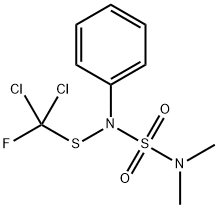
including storage diseases on many crops. | | Definition | ChEBI: A member of the class of sulfamides that is sulfamide in which the hydrogens attached to one of the nitrogens are replaced by methyl groups, while those attached to the other nitrogen are replaced by a phenyl and a [dichloro(fluoro)methyl]sulfanediyl group
A fungicide introduced in 1965 and used in the cultivation of fruit and vegetables, as well as in wood preservatives, it is no longer approved for use in the European Union. | | Metabolic pathway | Dichlofluanid contains an unstable dichlorofluoromethylthio (sulfenyl)
moiety that has been shown to undergo rapid hydrolytic and metabolic
degradation to N',N'-dimethyl-N-phenylsulfamide (2) (dimethylsulfanilide).
By analogy with captan, presumably the dichlorofluoromethylthio
moiety can be transferred to the sulfur atoms of cellular thiols such as
cysteine and glutathione. Thus in the presence of thiols, dichlofluanid
is probably cleaved at the N-S bond to form thiophosgene (3) or
its monofluoro analogue and other gaseous products such as hydrogen
sulfide, hydrogen chloride and carbonyl sulfide. Thiophosgene or its
monofluoro analogue is rapidly hydrolysed by water. The dichlorofluoromethylthio
group and thiophosgene may be intermediates in the
formation of addition products such as thiazolidine-2-thione-4-carboxylic
acid (4) by addition to cysteine. A thiazolidine derivative of glutathione
may also be formed (5). | | Degradation | Dichlofluanid is hydrolysed rapidly in alkaline conditions to form N',N'-
dimethyl-N-phenylsulfamide (2). The hydrolytic DT50 is >15 days, >18
hours and <10 minutes at pH 4,7 and 9, respectively, at 22 °C (PM).
Dichlofluanid is unstable to light and its fungitoxicity decreases on
exposure, albeit to a lesser extent than for captan. Dichlofluanid does not
absorb light of wavelength of >295 nm and so photodegradation is
unlikely to occur in the absence of photosensitisers. Dichlofluanid was
reacted in vitru with glutathone or cysteine in water/methanol solutions.
The reaction was carried out in a closed system at 40 °C using traps for
COS and CO2 and analysis by TLC. The proposed route of degradation
is given in Scheme 1. Short-lived intermediates are proposed that were
not detected. It is not clear whether thiophosgene (3) or its monofluoro
analogue were formed (Schuphan ef al., 1981).
The photolysis of dichlofluanid was studied under artificial conditions
that may not be relevant to typical environmental circumstances.
Unlabelled dichlofluanid in methanol, benzene or acetone solution was
irradiated with a medium pressure UV lamp (100 W) but the emission
wavelengths were not given. As they photodegraded, the methanol
and benzene solutions gave a brown solid and the acetone solution
darkened. Products were separated and identified using IR, GC and MS
methods. The products from acetone solution were N',N'-dimethyl-Nphenylsulfamide
(2), phenyl isocyanate (6), phenyl isothiocyanate (7) and
dimethylamidosulfonyl chloride (8). Studies using GC-MS indicated the
presence of bis(dichlorofluoromethyl) disulfide (9). It was concluded that
irradiation of dichlofluanid produced mainly the hydrolysis product
dimethylsulfanilide (2) and the very active dichlorofluoromethyl sulfide radical (.SCCl2F), the latter reacting with other compounds in solution.
For example, 1-(dichlorofluoromethylthio)propan-2-one (10), and 1-
(dichlorofluoromethylsulfonyl)propan-2-one(11) were formed in acetone
solution by reaction with solvent. The phenyl isothiocyanate (12) was also
isolated In vitro tests against Botrytis cinerea showed that irradiation
decreased the fungicidal activity of dichlofluanid (Clark and Watkins,
1978). |
| DICHLOFLUANID Preparation Products And Raw materials |
|


 日本语
日本语 한국어
한국어 Français
 Deutsch
 España
 Türkiye