Other grades of this product :
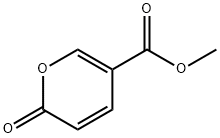
| Methyl coumalate Basic information |
| Product Name: | Methyl coumalate | | Synonyms: | Methyl 2-oxo-2H-pyran-5-carboxylate, Methyl 2-pyrone-5-carboxylate;2-Oxo-2H-pyran-5-carboxylic acid methyl ester;2-Oxopyran-5-carboxylic Acid Acid Methyl Ester;2-Pyrone-5-carboxylic Acid Methyl Ester;Methyl 2-Pyrone-5-carboxylate
Coumalic acid methyl ester;2H-Pyran-5-carboxylic acid, 2-oxo-, Methyl ester;Coumalic Acid Methyl Ester
2-Oxopyran-5-carboxylic Acid Methyl Ester
Methyl 2-Oxopyran-5-carboxylate
2-Pyrone-5-carboxylic Acid Methyl Ester
Methyl 2-Pyrone-5-carboxylate;methyl 6-oxopyran-3-carboxylate | | CAS: | 6018-41-3 | | MF: | C7H6O4 | | MW: | 154.12 | | EINECS: | 227-871-1 | | Product Categories: | Heterocycles;Intermediates & Fine Chemicals;Heterocycles series;Esters;Ring Systems;Pharmaceuticals | | Mol File: | 6018-41-3.mol |
| Methyl coumalate Chemical Properties |
| WGK Germany | 3 | | HS Code | 2932209090 |
| Methyl coumalate Usage And Synthesis |
| Uses | α, β-Unsaturated ketone Methyl Coumalate showed cytotoxicity against human normal gingival fibroblast cells and oral squamous cell carcinoma cell line-2. | | Uses | Methyl coumalate is a 2-pyrone and acts as dienophile in Diels-Alder reaction. It reacts with 1,3-butadienes at 100°C to yield tetrahydrocoumarins and 4-methoxycarbonyltricyclo[3.2.1.02,7]octenes. It also reacts with cyclohexadiene to afford tetrahydronaphthalene-2-carboxylate. It undergoes Diels-Alder reaction with unactivated alkenes to afford para-substituted adducts. It has been used as reagent in phosphine-catalyzed [4+3] annulation of modified allylic carbonates. It was also used in the preparation of 7-carboxyquinolizinium derivatives. | | Uses | Methyl coumalate has been used as reagent in phosphine-catalyzed [4+3] annulation of modified allylic carbonates. It was also used in the preparation of 7-carboxyquinolizinium derivatives. | | General Description | Methyl coumalate is a 2-pyrone and acts as dienophile in Diels-Alder reaction. It reacts with 1,3-butadienes at 100°C to yield tetrahydrocoumarins and 4-methoxycarbonyltricyclo[3.2.1.02,7]octenes. It also reacts with cyclohexadiene to afford tetrahydronaphthalene-2-carboxylate. It undergoes Diels-Alder reaction with unactivated alkenes to afford para-substituted adducts. |
| Methyl coumalate Preparation Products And Raw materials |
|


 日本语
日本语 한국어
한국어 Français
 Deutsch
 España
 Türkiye