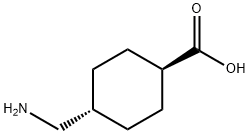
| Tranexamic Acid Basic information |
| Properties Coagulation and hemostasis drugs Indications Mechanism of action Pharmacokinetics Side effects |
| Product Name: | Tranexamic Acid |
| Synonyms: | TIMTEC-BB SBB006715;TRANS-4-AMINOMETHYL-1-CYCLOHEXANECARBOXYLIC ACID;trans-4-aminomethylcyclohexane-1-carboxylate;TRANS-4-(AMINOMETHYL)CYCLOHEXANECARBOXYLIC ACID;cyclocapron;cyklokapron;dv-79;emorhalt |
| CAS: | 1197-18-8 |
| MF: | C8H15NO2 |
| MW: | 157.21 |
| EINECS: | 214-818-2 |
| Product Categories: | Pharmaceutical intermediates;API's;4-Substituted Cyclohexanecarboxylic Acids;Amines;Chiral Reagents;Intermediates & Fine Chemicals;Pharmaceuticals;Building Blocks;C8;API;CYKLOKAPRON;Cosmetics;Hemostatic;Pharmaceutical raw materials;Carbonyl Compounds;Carboxylic Acids;Chemical Synthesis;Organic Building Blocks;1197-18-8 |
| Mol File: | 1197-18-8.mol |
| Tranexamic Acid Chemical Properties |
| Melting point | >300 °C (lit.) |
| Boiling point | 281.88°C (rough estimate) |
| density | 1.0806 (rough estimate) |
| vapor pressure | 1.72hPa at 25℃ |
| refractive index | 1.4186 (estimate) |
| storage temp. | 2-8°C |
| solubility | Freely soluble in water and in glacial acetic acid, practically insoluble in acetone and in ethanol (96 per cent). |
| form | Crystalline Powder |
| pka | pKa 4.3 (Uncertain);10.6 (Uncertain) |
| color | White |
| Water Solubility | 1g/6ml |
| Merck | 14,9569 |
| BRN | 2207452 |
| Stability: | Hygroscopic |
| InChIKey | GYDJEQRTZSCIOI-LJGSYFOKSA-N |
| CAS DataBase Reference | 1197-18-8 |
| Safety Information |
| Hazard Codes | Xi |
| Risk Statements | 36/37/38 |
| Safety Statements | 26-36-37/39 |
| WGK Germany | 2 |
| RTECS | GU8400000 |
| HazardClass | IRRITANT |
| HS Code | 29224999 |
| Toxicity | LD50 in mice, rats (mg/kg): 1500, 1200 i.v. (Melander) |
| MSDS Information |
| Provider | Language |
|---|---|
| Amstat | English |
| ACROS | English |
| SigmaAldrich | English |
| ALFA | English |
| Tranexamic Acid Usage And Synthesis |
| Properties | Amstat is an antifibrinolytic drug, commonly called Tranexamic acid. Tranexamic acid is a white crystalline powder. It is freely soluble in water and in glacial acetic acid and is very slightly soluble in ethanol and practically insoluble in ether. |
| Coagulation and hemostasis drugs | Tranexamic acid is a derivative of aminomethylbenzoic acid, and a kind of antifibrinolytic drugs to stop bleeding. The hemostasis mechanism of tranexamic acid is similar to aminocaproic acid and aminomethylbenzoic acid, but the effect is stronger. The strength is 7 to 10 times of aminocaproic acid, 2 times of aminomethylbenzoic acid, but toxicity is similar. The chemical structure of tranexamic acid is similar to lysine, competitive inhibition of plasmin original in fibrin adsorption, to prevent their activation, protection fiber protein not to degrade by plasmin and dissolve, eventually achieve hemostasis. Applicable in the treatment of acute or chronic, localized or systemic primary fiber fibrinolytic hyperthyroidism caused by bleeding, such as obstetric hemorrhage, renal hemorrhage, hemorrhage of hypertrophy of the prostate, hemophilia, pulmonary tuberculosis hemoptysis, stomach bleeding, after operation of liver, lung, spleen and other viscera hemorrhage; also can be used in surgery when abnormal bleeding etc.. Clinical tranexamic acid has effect significantly to insect bites disease, dermatitis and eczema, simple purpura, chronic urticaria, artificial sex urticaria, toxic eruption and eruption. And also has a certain effect on erythroderma, scleroderma, systemic lupus erythematosus (SLE), Erythema multiforme, shingles and alopecia areata. Treatment of hereditary angioedema effect is also good. In the treatment of Chloasma, general medicine is effective about 3 weeks, markedly effective 5 weeks, a course of 60 days. Given orally in doses of 0.25 ~ 0.5 g, a day 3 ~ 4 times. A few patients can nausea, fatigue, pruritus, abdominal discomfort, and diarrhea side effects after withdrawal symptoms disappear. |
| Indications |
|
| Mechanism of action | Tranexamic acid is a synthetic lysine amino acid derivative, which diminishes the dissolution of hemostatic fibrin by plasmin. In the presence of tranexamic acid, the lysine receptor binding sites of plasmin for fibrin are occupied, preventing binding to fibrin monomers, thus preserving and stabilizing fibrin’s matrix structure. |
| Pharmacokinetics | After a single oral administration of two 650 mg tablets of LYSTEDA, the peak plasma concentration (Cmax ) occurred at approximately 3 hours (Tmax ). The absolute bioavailability of LYSTEDA in women aged 18-49 is approximately 45%. Following multiple oral doses (two 650 mg tablets three times daily). administration of LYSTEDA for 5 days, the mean C max increased by approximately 19% and the mean area under the plasma concentration-time curve (AUC) remained unchanged, compared to a single oral dose administration (two 650 mg tablets). Plasma concentrations reached steady state at the 5th dose of LYSTEDA on Day 2. |
| Side effects | The table below contains some of the side-effects associated with tranexamic acid, although these occur only rarely.
▼ ▲
Tranexamic acid side-effects
What can I do if I experience this?
Feeling or being sick
Stick to simple meals avoid rich and spicy food. If you are not already doing so, try taking the tablets after meals
Diarrhoea
Drink plenty of water to replace the lost fluids
Eyesight problems (such as problems with your colour vision)
Let your doctor know about this as soon as possible as your treatment will need to be reviewed
|
| Chemical Properties | White or almost white, crystalline powder. |
| Originator | Anvitoff,Knoll,W. Germany,1967 |
| Uses | Antifibrinolytic agent; blocks lysine binding sites of plasminogen. Hemostatic. |
| Uses | Used as lysine analogue to characterize binding sites in plasminogen |
| Uses | Fibrinolysis, the cleavage of fibrin by plasmin, is a normal step in the dissolution of fibrin clots after wound repair. Tranexamic acid is an inhibitor of fibrinolysis that blocks the interaction of plasmin with fibrin (IC50 = 3.1 μM). It is a lysine mimetic that binds the lysine binding site in plasmin. Antifibrinolytic agents have value when fibrinolytic activity is abnormally high or when coagulation is impaired. |
| Manufacturing Process | In an autoclave, 2 grams of a mixture of cis- and trans-4- aminomethylcyclohexane-1-carboxylic acid, which is obtained by catalytic reduction of p-aminomethylbenzoic acid in the presence of platinum catalyst and contains 60% by weight of cis-isomer was reacted at 200°C, for 8 hours with 20 ml of ethyl alcohol in which 0.44 gram of sodium metal had been dissolved. After cooling, the reaction solution was concentrated under a reduced pressure to give a white residue. This residue was dissolved in 40 ml of water and passed through a column of a strongly acidic cation ion_x0002_exchanger resin (NH4+). The eluate was concentrated under reduced pressure to form a white mass. An adequate amount of acetone was added thereto and 1.95 grams of white powder was obtained. This powder was recrystallized from water-acetone to give 1.85 grams (yield, 92.5%) of white crystalline powder having a melting point of 380° to 390°C (decomposition). This product was identified as trans-4-aminomethylcyclohexane-1-carboxylic acid by means of infrared spectrum. |
| Therapeutic Function | Coagulant |
| General Description | Pharmaceutical secondary standards for application in quality control provide pharma laboratories and manufacturers with a convenient and cost-effective alternative to the preparation of in-house working standards |
| Flammability and Explosibility | Notclassified |
| Mechanism of action | Tranexamic acid can also be viewed as a structural analog of lysine. It is presumed that it works by the same mechanism as aminocaproic acid; however, it is 6–10 times more active. It inhibits action of a plasmin and plasminogen inhibitor, and has a hemostatic effect. |
| Clinical Use | Haemostatic agent |
| Synthesis | Tranexamic acid, trans-4-(aminomethyl)cyclohexane carboxylic acid (24.4.5), is synthesized from 4-methylbenzonitrile. Oxidation of the methyl group gives the mononitrile of terephthalic acid 24.4.2. The cyano group in this compound is reduced by hydrogen using Raney nickel as a catalyst. The benzene ring of the resulting 4- aminomethylbenzoic acid (24.4.3) is reduced to a cyclohexane moiety by hydrogen and a platinum catalyst, which forms an isomeric mixture of 4-aminomethylcyclohexane carboxylic acids (24.4.4), and the desired trans-isomer 24.4.5 is isolated by crystallization of the mixture of its sodium salts. |
| Drug interactions | Potentially hazardous interactions with other drugs None known |
| Metabolism | Tranexamic acid is excreted as unchanged drug mainly by urinary excretion via glomerular filtration. |
| Tranexamic Acid Preparation Products And Raw materials |
Please leave a message for us or use the following ways to contact us, we will reply to you as soon as possible, and provide you with the most sincere service, thank you.


 日本语
日本语 한국어
한국어 Français
 Deutsch
 España
 Türkiye