Other grades of this product :
| 6-Chlorouracil Basic information |
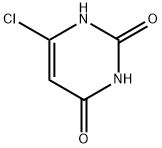
| Product Name: | 6-Chlorouracil | | Synonyms: | 6-chloro-1H-pyrimidine-2,4-dione;Chlorouracil;6-Chlorouracil ,99%;2,4(1H,3H)-Pyrimidinedione, 6-chloro- (9CI);6-Chlorouracil,98+%;4-Chloro-2,6-dihydroxypyrimidine, 6-Chloro-2,4-dihydroxypyrimidine, 6-Chlorouracil;Tragliptin Starter 1 Impurity 4;6-chloro-1,2,3,4-tetrahydropyriMidine-2,4-dione | | CAS: | 4270-27-3 | | MF: | C4H3ClN2O2 | | MW: | 146.53 | | EINECS: | 224-258-0 | | Product Categories: | PYRIMIDINE;Pyridines, Pyrimidines, Purines and Pteredines;Biochemistry;Nucleobases and their analogs;Nucleosides, Nucleotides & Related Reagents | | Mol File: | 4270-27-3.mol |
| 6-Chlorouracil Chemical Properties |
| Melting point | 290-295°C | | Boiling point | 300°C | | density | 1.61±0.1 g/cm3(Predicted) | | storage temp. | Keep in dark place,Sealed in dry,Room Temperature | | solubility | Soluble in Ammonium Hydroxide | | pka | 6.24±0.10(Predicted) | | form | Solid | | color | White | | Water Solubility | 4.885g/L(25 ºC) | | BRN | 120492 | | InChIKey | PKUFNWPSFCOSLU-UHFFFAOYSA-N | | CAS DataBase Reference | 4270-27-3(CAS DataBase Reference) | | NIST Chemistry Reference | 6-Chlorouracil(4270-27-3) |
| Hazard Codes | Xi | | Risk Statements | 36/37/38 | | Safety Statements | 26-36 | | WGK Germany | 3 | | HazardClass | IRRITANT | | HS Code | 29335990 |
| 6-Chlorouracil Usage And Synthesis |
| Chemical Properties | White to off-white powder | | Uses | 6-Chlorouracil acts as an inhibitor of yeast alcohol dehydrogenase (ADH-H). 6-Chlorouracil is a potential inhibitor of DNA repair glycosylases. | | Uses | Chlorouracil (4-Chlorouracil; 6-Chlorouracil) is a halogenated uracil that is useful in studies of the effects of halogenation on nucleic acid base-pair stability and alkali metal ion affinity. Reaction of 6-chlorouracil with 4-(dimethylamino)pyridine, 4-methylpyridine, and pyridin-4-yl-morpholine yielded pyridinium-substituted uracils as chlorides which were converted into pyridinium uracilates by deprotonation. These heterocyclic mesomeric betaines are cross-conjugated and thus possess separate cationic (pyridinium) and anionic (uracilate) moieties. Calculations and X-ray single crystal analyses may be used to characterize these systems and to compare the salts with the betaines. |
| 6-Chlorouracil Preparation Products And Raw materials |
|


 日本语
日本语 한국어
한국어 Français
 Deutsch
 España
 Türkiye