Other grades of this product :
| DIMETHIRIMOL Basic information |
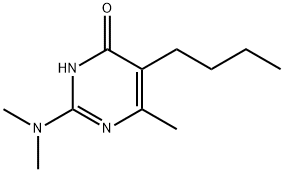
| Product Name: | DIMETHIRIMOL | | Synonyms: | 'LGC' (1633);DIMETHIRIMOL;MILCURB;2-dimethylamino-4-hydroxy-5-n-butyl-6-methylpyrimidine;2-dimethylamino-4-methyl-5-n-butyl-6-hydroxypyrimidine;5-butyl-2-(dimethylamino)-6-methyl-4(1h)-pyrimidinone;5-butyl-2-(dimethylamino)-6-methyl-4-pyrimidinol;DiMethiriMol 0 | | CAS: | 5221-53-4 | | MF: | C11H19N3O | | MW: | 209.29 | | EINECS: | 226-021-7 | | Product Categories: | | Mol File: | 5221-53-4.mol |
| DIMETHIRIMOL Chemical Properties |
| Melting point | 103℃ | | Boiling point | 348.66°C (rough estimate) | | density | 1.0465 (rough estimate) | | vapor pressure | 1.5 x 10⁻³ Pa at 30 °C | | refractive index | 1.5700 (estimate) | | storage temp. | 0-6°C | | pka | 5 | | Water Solubility | 1.2 g l-1 (25 °C) | | EPA Substance Registry System | Dimethirimol (5221-53-4) |
| Hazard Codes | Xn | | Risk Statements | 21-52 | | Safety Statements | 36/37 | | Toxicity | LD50 in female rats (mg/kg): 200-400 i.p., >4000 orally (Elias) |
| DIMETHIRIMOL Usage And Synthesis |
| Uses | Fungicide. | | Uses | Dimethirimol is a systemic fungicide that provides both protective
and curative control of powdery mildew (Sphaeratheca fulginea)
in cucurbits. Other uses include tobacco, tomatoes and ornamentals. | | Uses | Dimethrimolis a fungicide used initially to prevent powdery mildew and other fungal infections or crops. Pesticide. | | Definition | ChEBI: A member of the class of aminopyrimidines that is 2-dimethylaminopyrimidine carrying methyl, butyl and hydroxy substituents at posiitons 4, 5 and 6 respectively. A fungicide first marketed in 1970, and used particularly in glasshouses to control powdery mi
dew, it is no longer approved for use within the European Union. | | Metabolic pathway | Information presented in this summary is abstracted from unpublished
data in the 1971 ICI dimethirimol petition submitted to the Canadian
authority. Dimethirimol is rapidly metabolised in both plants and
animals. Primary metabolic reactions in soils, plants and animals are
N-dealkylation, hydroxylation of the butyl group and the direct conjugation
of dimethirimol in plants (glucosides) and animals (glucuronides).
Metabolic pathways are shown in Scheme 1. | | Degradation | Dimethirimol (1) is stable to heat and in acid and alkahe solutions. It is
decomposed rather rapidly in aqueous solution when exposed to sunlight
with an observed DT50 of 7 days. |
| DIMETHIRIMOL Preparation Products And Raw materials |
|


 日本语
日本语 한국어
한국어 Français
 Deutsch
 España
 Türkiye