Other grades of this product :
| BETA-CYPERMETHRIN Basic information |
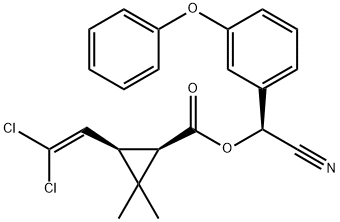
| Product Name: | BETA-CYPERMETHRIN | | Synonyms: | ASYMETHRIN;beta-CyperMethri;Bata-cypermethrin;Alphamethrin Solution, 1000ppm;(1R)-2,2-Dimethyl-3β-(2,2-dichlorovinyl)cyclopropane-1β-carboxylic acid (S)-α-cyano-3-phenoxybenzyl ester;(1R)-3β-(2,2-Dichloroethenyl)-2,2-dimethylcyclopropane-1β-carboxylic acid (S)-α-cyano-3-phenoxybenzyl ester;(1R,3R)-3-(2,2-Dichlorovinyl)-2,2-dimethylcyclopropanecarboxylic acid (S)-α-cyano-3-phenoxybenzyl ester;(1R,3R)-3-(2,2-Dichlorovinyl)-2,2-dimethylcyclopropanecarboxylic acid (αS)-α-cyano-3-phenoxybenzyl ester | | CAS: | 65731-84-2 | | MF: | C22H19Cl2NO3 | | MW: | 416.3 | | EINECS: | 265-898-0 | | Product Categories: | | Mol File: | 65731-84-2.mol |
| BETA-CYPERMETHRIN Chemical Properties |
| BETA-CYPERMETHRIN Usage And Synthesis |
| Uses | Beta-cypermethrin is used to control a wide range of insects, especially
Lepidoptera and Coleoptera, in alfalfa, cotton, cereals, fruit, vines,
vegetables, beans, beets, tobacco, oilseed rape and other crops. It is also
used for insect control in public health and for ectoparasite control on
animals. | | Uses | (1R,2R,1''S)-Cypermethrin functions as a degartion product (Pyrethroid insecticides) used in agriculture. Insecticidal activity of most active isomers of fenvalerate and other recent pyrethroids. | | Metabolic pathway | Beta-cypermethrin is composed of two of the four cis-cypermethrin isomers
(1RcisaS and 1ScisaR isomers) [i.e. alpha-cypermethrin] and two of
the four trans-cypermethrin isomers (1RtransaS and 1StransaR) [i.e. thetacypermethrin].
The fate of these four isomers (separately) has been
reported for soils. Metabolite analysis was conducted in enough detail to
indicate that the fate of the components was very similar to their fate
when presented to biological systems as part of cypermethrin. Thus reference
can be made to the cypermethrin entry for details. The structure and
Scheme numbering used below refers to the cypermethrin entry. | | Degradation | Beta-cypermethrin is stable as a solid but it is epimerised in weak base
solution and readily hydrolysed at higher pH. Its half-lives at pH values
3, 7 and 9 (25 °C) were 50,40 and 15 days (PM). By analogy with cypermethrin,
the rate-determining step in dilute solution is nucleophilic attack
by OH-. Half-lives of cis-cypermethrin in river water and sea water at
25 °C were 21 and 24 days, respectively; the trans-isomer would be
expected to be more rapidly degraded. Major products were 3-(2,2-
dichlorovinyl)-2,2-dimethylcyclopropanecarboxylic acid (2, DCVA), 3-
phenoxybenzaldehyde (9, 3PBAl) and a-carbamoyl-3-phenoxybenzyl
3-(2,2-dichlorovinyl)-2,2-dimethylcyclopropanecarboxylate( the amide
3); minor products were the a-carboxy analogue of 3 (4) and 3-
phenoxybenzoic acid (10,3PBA) (see cypermethrin, Schemes la and lb).
Photodecomposition would be expected to be similar to that of
cypermethrin. |
| BETA-CYPERMETHRIN Preparation Products And Raw materials |
|


 日本语
日本语 한국어
한국어 Français
 Deutsch
 España
 Türkiye