Other grades of this product :
| ROLIPRAM Basic information |
| ROLIPRAM Chemical Properties |
| Melting point | 127-133 °C | | Boiling point | 418.29°C (rough estimate) | | density | 1.0677 (rough estimate) | | refractive index | 1.5500 (estimate) | | storage temp. | Sealed in dry,Store in freezer, under -20°C | | solubility | H2O: 0.2 mg/mL | | form | solid | | pka | 16.02±0.40(Predicted) | | color | white to off-white | | Merck | 14,8251 | | Stability: | Stable for 2 years from date of purchase as supplied. Solutions in DMSO or ethanol may be stored at -20°C for up to 3 months. |
| Hazard Codes | Xi | | Risk Statements | 36/37/38-11 | | Safety Statements | 26-36 | | RIDADR | 3249 | | WGK Germany | 3 | | RTECS | UY5749237 | | HazardClass | 6.1(b) | | PackingGroup | III | | HS Code | 29337900 | | Toxicity | LD50 oral in mouse: > 300mg/kg |
| ROLIPRAM Usage And Synthesis |
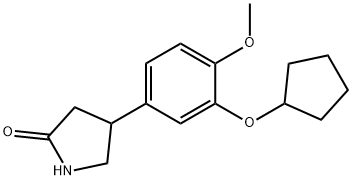
| Description | Rolipram (61413-54-5) is a selective inhibitor of cAMP-specific phosphodiesterase (PDE4), IC50 = 1 μM. Displays beneficial effects in neurodegenerative diseases. Rolipram also displays anti-inflammatory activity and synergizes with forskolin (cat.# 10-2073). Cell permeable. | | Chemical Properties | Yellowish solid | | Uses | antipsychotic | | Uses | A selective, cell permeable inhibitor of cAMP-specific phosphodiesterase (PDE4). | | Uses | Pharmacological tool for characterization of phosphodiesterase isoenzymes. | | Uses | (±)-Rolipram is a cAMP-specific phosphodiesterase 4 (PDE4) inhibitor. | | General Description | A cell-permeable, selective inhibitor of cAMP-specific phosphodiesterase (PDE IV; IC50 = 800 nM). A rolipram-insensitive PDE IV subtype is also known to exist. Also inhibits NF-κB and NFAT activation in Jurkat and primary T cells. | | Biological Activity | Selective inhibitor of cAMP phosphodiesterase (PDE4) (IC 50 = 2.0 μ M). Discriminates between two conformational states of PDE4 isoenzymes. See separate isomers ((R)-(-)-Rolipram and (S)-(+)-Rolipram). | | Biochem/physiol Actions | Cell permeable: yes | | References | 1) Reeves et al. (1987), The identification of a new cyclic nucleotide phosphodiesterase activity in human and guinea-pig cardiac ventricle. Implications for the mechanism of action of selective phosphodiesterase; Biochem. J., 241 535
2) Nishi et al. (2008), Distinct Roles of PDE4 and PDE10A in the Regulation of cAMP/PKA Signaling in the Striatum; J. Neurosci., 28 10460
3) Christiansen et al. (2011), Combined anti-inflammatory effects of β2-adrenergic agonists and PDE4 inhibitors on astrocytes by upregulation of intracellular cAMP; Neurochem. Int., 59 837 |
| ROLIPRAM Preparation Products And Raw materials |
|


 日本语
日本语 한국어
한국어 Français
 Deutsch
 España
 Türkiye