Other grades of this product :
| 4-tert-Butylcatechol Basic information |
| 4-tert-Butylcatechol Chemical Properties |
| Melting point | 52-55 °C(lit.) | | Boiling point | 285 °C(lit.) | | density | 1.049 | | vapor pressure | <1 hPa (25 °C) | | refractive index | n20/D 1.508 | | Fp | >230 °F | | storage temp. | Store below +30°C. | | solubility | methanol: soluble1g/10 mL, clear, colorless to slightly yellow | | pka | 9.92±0.10(Predicted) | | form | powder to lump | | color | White to Light yellow to Light red | | Water Solubility | 0.2 g/100 mL (25 ºC) | | Sensitive | Hygroscopic | | BRN | 2043335 | | Exposure limits | ACGIH: TWA 5 ppm (Skin)NIOSH: TWA 5 ppm(20 mg/m3) | | InChIKey | XESZUVZBAMCAEJ-UHFFFAOYSA-N | | LogP | 1.98 at 25℃ | | CAS DataBase Reference | 98-29-3(CAS DataBase Reference) | | NIST Chemistry Reference | 1,2-Benzenediol, 4-(1,1-dimethylethyl)-(98-29-3) | | EPA Substance Registry System | p-tert-Butylcatechol (98-29-3) |
| 4-tert-Butylcatechol Usage And Synthesis |
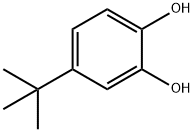
| Description | Para-tertiary butyl catechol is specially prepared by
reacting the impure catechol fraction with tertiary
butyl alcohol. Used for its various properties (inhibition
of polymerization and as an antioxidizing agent)
in the manufacture of rubber, plastics and paints, in
the preparation of petrolatum products, and as an
antioxidant in oils, it may induce vitiligo. | | Chemical Properties | white to cream flakes | | Uses | Polymerization inhibitor for styrene-butadiene and other olefins.Inhibitor-remover packings and ready-to-use, disposable prepacked columns offer a quick and convenient means of removing small amounts of inhibitors which are added to reagents or solvents that would otherwise be unstable (e.g., they may polymerize, oxidize or darken) on storage.The inhibitor removers are useful in applications which require that the stabilizer or inhibitor [i.e., hydroquinone (HQ), hydroquinone monomethyl ether (MEHQ, 4-methoxyphenol) or 4-tert-butylcatechol (TBC)] be removed prior to use. | | Uses | 4-tert-butylcatechol (PTBC) is used as an antioxidant in fats, oils, and mineral oils, and as a stabilizer in polyester resins and polystyrene resins. A concentration of PTBC (up to 0.005%) can be found in paints, glues, thermal paper, lubricating oil, and mineral oil products.4-tert-Butylcatechol is widely utilized as an inhibitor in polymerization of butadiene, styrene, vinyl acetate and other reactive monomers. It plays an important role in the synthesis of tungsten oxide nanoparticles by nonaqueous sol-gel process. It acts as a stabilizer in the manufacturing of polyurethane foam. It is employed as an antioxidant for synthetic rubber, polymers and oil derivatives. It is also utilized as a purification agent for aminoformate catalysts. | | General Description | 4-tert-Butylcatechol,in the presence of O2 catalyzed by tyrosinase, yields 4-tert-butyl-o-benzoquinone. Electrochemical oxidation of 4-tert-Butylcatechol in the presence of 4-hydroxycoumarin as nucleophile has been studied using cyclic voltammetry and controlled-potential coulometry. It undergoes electrochemical trimerization via anodic oxidation and mechanism of trimerization has been studied using cyclic voltammetry and controlled-potential coulometry. | | Hazard | Toxic by ingestion and skin absorption.
| | Flammability and Explosibility | Notclassified | | Contact allergens | p-tert-Butyl catechol is specially prepared by reacting
the impure catechol fraction with tertiary butyl alcohol.
It is used for its various properties (inhibitor of
polymerization and antioxidizing agent) in the manufacture
of rubber, plastics, and paints, in the preparation
of petrolatum products, and as an antioxidant in
oils. It may induce vitiligo. | | Safety Profile | A poison by
intravenous route. Moderately toxic by
ingestion and skin absorption. A severe skin
and eye irritant. Mutation data reported.
Combustible when exposed to heat or
flame. To fight fire, use Con, dry chemical,
fog, mist. When heated to decomposition it
emits acrid and irritating fumes | | Purification Methods | Distil it in a vacuum, then recrystallise it from pentane or pet ether (or *C6H6). [Beilstein |
| 4-tert-Butylcatechol Preparation Products And Raw materials |
|


 日本语
日本语 한국어
한국어 Français
 Deutsch
 España
 Türkiye