Other grades of this product :
| Chlorohydroquinone Basic information |
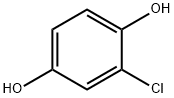
| Product Name: | Chlorohydroquinone | | Synonyms: | 2-CHLOROHYDROQUINONE: TECH., 90%;2-Chlorobenzene-1,4-diol;Chlorohydroquinone, 90%, tech.;Chlorohydroquinone,99%;Chlorohydroquinone, tech., 90% 5GR;Chlorohydroquinone (Technical Grade, ~90%);2-Chlorohydroquinone, tech. 90%, tech. 90%;Chlorohydroquinone technical grade, 85% | | CAS: | 615-67-8 | | MF: | C6H5ClO2 | | MW: | 144.56 | | EINECS: | 210-442-8 | | Product Categories: | Dye Intermediate;Anthraquinones, Hydroquinones and Quinones | | Mol File: | 615-67-8.mol |
| Chlorohydroquinone Chemical Properties |
| Melting point | 100-104 °C (lit.) | | Boiling point | 263 °C (lit.) | | density | 1.2558 (rough estimate) | | refractive index | 1.4620 (estimate) | | Fp | 263°C | | storage temp. | Inert atmosphere,Room Temperature | | solubility | DMSO (Slightly), Methanol (Slightly) | | pka | 9.21±0.18(Predicted) | | form | Fine Crystalline Powder | | color | Light brown to gray | | Water Solubility | soluble | | BRN | 636835 | | CAS DataBase Reference | 615-67-8(CAS DataBase Reference) | | NIST Chemistry Reference | 1,4-Benzenediol, 2-chloro-(615-67-8) | | EPA Substance Registry System | Chlorohydroquinone (615-67-8) |
| Hazard Codes | Xn,Xi | | Risk Statements | 21-36/37/38-43 | | Safety Statements | 36/37-37/39-26 | | RIDADR | UN2811 | | WGK Germany | 3 | | RTECS | MX4800000 | | TSCA | Yes | | HazardClass | 6.1 | | PackingGroup | III | | HS Code | 29081990 | | Hazardous Substances Data | 615-67-8(Hazardous Substances Data) | | Toxicity | An antidiarrhea drug used
extensively in Japan. It has been shown to be the cause of subacute
myelooptic neuropathy, a syndrome in which stiffness of
the joints is accompanied by damage to the optic nerve. |
| Chlorohydroquinone Usage And Synthesis |
| Chemical Properties | light brown to grey fine crystalline powder. It precipitates leafy crystals from chloroform and needle-like crystals from toluene. Freely soluble in water and alcohol, slightly soluble in ether and hot chloroform. | | Uses | Chlorohydroquinone is a component of polyethers based on organotin with potential application to breast cancer treatment via growth inhibition. Also a component in the synthesis of contraceptive agents in pharmaceutical compounds. It is also used within hydroxylation and catalysis organic reactions in the synthesis of pharmacologically active phenolic compounds. | | Preparation | Chlorohydroquinone is obtained by reacting p-benzoquinone with hydrochloric acid. First dissolve p-benzoquinone with chloroform and pass dry hydrogen chloride gas under cooling to obtain. | | Application | Chlorohydroquinone is a benzenediol that consists of hydroquinone bearing a single chloro substituent. It has a role as a metabolite. It is a member of monochlorobenzenes and a member of chlorohydroquinones. Chlorohydroquinone is used in photographic developing solutions. It is also a bactericide. | | Definition | ChEBI: Chlorohydroquinone is a benzenediol that consists of hydroquinone bearing a single chloro substituent. It has a role as a metabolite. It is a member of monochlorobenzenes and a member of chlorohydroquinones. | | Safety Profile | Poison by ingestion and
intraperitoneal routes. Moderately toxic by
skin contact. Experimental reproductive
effects. When heated to decomposition it
emits toxic fumes of Cl-. See also
CHLORIDES. | | Purification Methods | Crystallise the hydroquinone from CHCl3 or toluene. [Beilstein 6 IV 5767.] |
| Chlorohydroquinone Preparation Products And Raw materials |
|


 日本语
日本语 한국어
한국어 Français
 Deutsch
 España
 Türkiye