Other grades of this product :
| Bis(tributyltin) oxide Basic information |
| Bis(tributyltin) oxide Chemical Properties |
| Melting point | -45°C | | Boiling point | 180 °C2 mm Hg(lit.) | | density | 1.17 g/mL at 25 °C(lit.) | | vapor pressure | <0.01 mm Hg ( 25 °C) | | refractive index | n20/D 1.486(lit.) | | Fp | >230 °F | | storage temp. | +4°C
| | solubility | Chloroform (Soluble), Methanol (Slightly) | | form | liquid | | Specific Gravity | 1.170 | | color | colorless | | Water Solubility | INSOLUBLE | | Sensitive | Air & Moisture Sensitive | | Hydrolytic Sensitivity | 5: forms reversible hydrate | | BRN | 745057 | | Exposure limits | ACGIH: TWA 0.1 mg/m3; STEL 0.2 mg/m3 (Skin)NIOSH: IDLH 25 mg/m3; TWA 0.1 mg/m3 | | Stability: | Moisture Sensitive | | InChIKey | APQHKWPGGHMYKJ-UHFFFAOYSA-N | | CAS DataBase Reference | 56-35-9(CAS DataBase Reference) | | NIST Chemistry Reference | Distannoxane, hexabutyl-(56-35-9) | | EPA Substance Registry System | Bis(tributyltin) oxide (56-35-9) |
| Bis(tributyltin) oxide Usage And Synthesis |
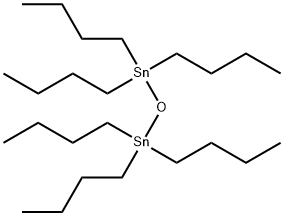
| Description | TBTO (bis(tri-n-butyltin)oxide) appears as thin, colourless to pale yellow, flammable and
combustible liquid. It is soluble in organic solvents. TBTO, or bis(tri-n-butyltin)oxide, is an
organotin compound used as a biocide, fungicide, and molluscicide. Uses of tributyltin also
include as an anti-fouling chemical in marine paints for boats, anti-fungal agent in textiles
and industrial water systems, in cooling tower and refrigeration water systems, wood pulp
preservative in paints and paper mill systems, inner surfaces of cardboard, and in the manufacturing
processes of leather goods, textiles, wood, plastics, and mothproof stored garments.
In fact, TBT compounds are considered the most hazardous of all tin compounds. | | Chemical Properties | Clear colorless liquid | | Uses | Bis(tributyltin) Oxide is an organotin compound used as a fungicide and molluscicide, particularly in wood preservation. Bis(tributyltin) Oxide was used as an active component in marine antifouling paints but is not longer used due to its toxicity and is considered a severe marine pollutant. | | Uses | Bis(tributyltin) oxide is widely used in Europe for the preservation of timber, millwork, and wood joinery, eg, window sashes and door frames. It is applied from organic solution by dipping or vacuum impregnation. It imparts resistance to attack by fungi and insects but is not suitable for underground use. An advantage of bis(tributyltin) oxide is that it does not interfere with subsequent painting or decorative staining and does not change the natural color of the wood. | | Uses | Tributyltin oxide is used as an antifouling and biocide
agent against fungi, algae and bacteria in paints and is
an irritant. | | General Description | Clear pale yellow liquid. Toxic by skin absorption or inhalation of vapors. Used as a bactericide, fungicide and chemical intermediate. | | Air & Water Reactions | Insoluble in water. | | Reactivity Profile | Bis(tributyltin) oxide may react vigorously with oxidizing agents and with reducing agents. | | Hazard | Toxic via ingestion and inhalation.
| | Health Hazard | ACUTE/CHRONIC HAZARDS: Bis(tributyltin) oxide is toxic by ingestion and inhalation and is a skin and eye irritant. | | Fire Hazard | Bis(tributyltin) oxide is probably combustible. | | Contact allergens | Tributyl tin oxide is used as an antifouling and biocide
agent against fungi, algae, and bacteria, particularly in
paints. Sometimes used in chemistry, tributyltin oxide is
a strong irritant. |
| Bis(tributyltin) oxide Preparation Products And Raw materials |
|


 日本语
日本语 한국어
한국어 Français
 Deutsch
 España
 Türkiye