Other grades of this product :
| 1-Adamantanol Chemical Properties |
| Melting point | 247 °C (subl.) (lit.) | | Boiling point | 214.73°C (rough estimate) | | density | 0.8544 (rough estimate) | | refractive index | 1.4880 (estimate) | | Fp | 240°C | | storage temp. | Sealed in dry,Room Temperature | | solubility | Chloroform (Sparingly), Methanol (Slightly) | | form | Crystalline Powder or Needles | | pka | 15.38±0.20(Predicted) | | color | White to off-white | | Water Solubility | Soluble in ethanol , methanol, and diethyl ether. Partly miscible in water. | | Sublimation | 240 ºC | | BRN | 1903952 | | InChIKey | VLLNJDMHDJRNFK-UHFFFAOYSA-N | | CAS DataBase Reference | 768-95-6(CAS DataBase Reference) | | NIST Chemistry Reference | 1-Adamantanol(768-95-6) |
| Hazard Codes | Xi | | Risk Statements | 36/37/38 | | Safety Statements | 22-24/25-36-26 | | WGK Germany | 3 | | RTECS | AU4980000 | | Hazard Note | Irritant | | HS Code | 29061900 |
| 1-Adamantanol Usage And Synthesis |
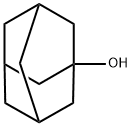
| Outline | 1-adamantanol is also known as 1-hydroxide adamantane, 1-tricyclo [3.3.1.1 (3.7)] decyl alcohol. At room temperature, it is white crystalline powder with the melting point higher than 240 ℃. It is soluble in organic solvents and insoluble in water with sublimation property. It can be used for the manufacture of synthetic adamantane derivatives and adapalene. It can react with vinylidene chloride to generate 1-adamantane acetic acid. 1-adamantyl acetate can further undergo bromination and hydrolyzed into 3-hydroxy-1-adamantyl acetate which can further react with vinylidene chloride to give 1, 3-adamantane di-acetic acid.
1-adamantanol can have Friedel-Crafts alkylation reaction acetanilide in the 98% sulfuric acid medium at room temperature for direct synthesis of 1, 3-bis (4-acetylamino-phenyl) adamantane which can undergo alkaline hydrolysis for synthesis of 1, 3 bis (4-aniline) adamantane. The synthetic route has many advantages including relative high reaction yield and easy purification, etc., therefore greatly facilitating the synthesis of 1, 3-diaryl adamantane derivatives.
The above information is edited by the Chemicalbook of Dai Xiongfeng.
| | Uses | 1-adamantanol can be used as the intermediate for synthesis of adamantanes derivatives. For example, it can be used for the manufacture of synthetic adamantane derivatives and adapalene. It can react with vinylidene chloride to give 1-adamantane acetic acid.
| | Chemical Properties | white to off-white crystalline powder or needles | | Uses | 1-Adamantanol was used in the preparation of 1,3-adamantanediol. It is used in the manufacture of synthetic adamantane derivatives and adapalene. | | Synthesis Reference(s) | Synthetic Communications, 19, p. 2061, 1989 DOI: 10.1080/00397918908052598Tetrahedron Letters, 28, p. 1941, 1987 DOI: 10.1016/S0040-4039(00)96015-5 | | Purification Methods | If 2-adamantanol is a suspected impurity, then dissolve the substance (10g) in acetone (100mL) and add Jones's reagent [CrO3 (10.3g) in H2O (30mL)], then conc H2SO4 (8.7mL) is added dropwise (turns green in colour) until excess reagent is present (slight red colour). Stir overnight, decant the acetone solution from the Cr salts and adamantan-2-one, dry (Na2SO4) and evaporate to dryness. The residue (ca 7g) is chromatographed through Al2O3 (250g) and washed with 50% *benzene/pet ether (b 40-60o), then 100% Et2O (to remove any adamantan-2-one present) and the 1-adamantanol is then eluted with 5% MeOH in Et2O. The eluate is evaporated, and the residue is recrystallised from pet ether (b 30-60o) at -70o, m 287.2-288.5o. It also crystallises from MeOH and can be sublimed in vacuo. It has characteristic IR, max 3640, 1114, 1086, 982 and 930cm-1. [Schleyer & Nicholas J Am Chem Soc 83 182 1961.] [Beilstein 6 IV 391.] Alternatively, if free from the 2-isomer, dissolve it in tetrahydrofuran, dilute with H2O to precipitate the alcohol. Collect, dry and sublime it in a vacuum at 130o. [Stetter et al. Chem Ber 92 1629 1959.] |
| 1-Adamantanol Preparation Products And Raw materials |
|


 日本语
日本语 한국어
한국어 Français
 Deutsch
 España
 Türkiye