Other grades of this product :
| β-Nicotinamide adenine dinucleotide Basic information |
| β-Nicotinamide adenine dinucleotide Chemical Properties |
| β-Nicotinamide adenine dinucleotide Usage And Synthesis |
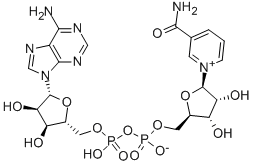
| Description | β-Nicotinamide adenine dinucleotide (NAD+) plays a major role in metabolism as a cofactor and mobile electron acceptor. NAD+ is a required oxidizing cosubstrate for many enzymes. It is reduced to NADH (Cat# N-035) which carries electrons to the electron transport chain for subsequent oxidative phorphorylation and ATP production. NAD+ is capable of donating ADP-ribose moieties to a protein, producing nicotinamide in the process. Sirtuin enzymes use NAD+ as a substrate to deacetylate proteins and direct activity between the nucleus and mitochondria. NAD+ is regenerated by fermentation and by oxidative phosphorylation. | | Chemical Properties | Beta-Nicotinamide adenine dinucleotide is a hygroscopic white powder. It should be stored desiccated. Store in cool place. Keep container tightly closed in a dry and well-ventilated place. Recommended storage temperature -20°C. | | Uses | β-Nicotinamide Adenine Dinucleotide is a coeznyme consisting of an adenine base and a nicotinamide base connected by a pair of bridging phosphate group. β-Nicotinamide Adenine Dinucleotide acts as a c oenzyme in redox reactions, as a donor of ADP-ribose moieties in ADP-ribosylation reactions and also as a precursor of the second messenger molecule cyclic ADP-ribose. β-Nicotinamide Adenine Dinucleot ide also acts as a substrate for bacterial DNA ligases and a group of enzymes called sirtuins that use NAD+ to remove acetyl groups from proteins.
| | Application | β-Nicotinamide adenine dinucleotide (β-NAD) is a cofactor of alcohol dehydrogenase and acts as a neuromodulator and an inhibitory neurotransmitter in visceral smooth muscles. The NAD/NADH ratio has a role in the regulation of intracellular redox potential. It thereby influences metabolic reactions in vivo. It has been used for the preparation of deacetylated tubulin. It has also been used for UDP-glucose-6-hydrogenase (UGDH) enzyme activity assay of orital fibroblast cell lysates.β-Nicotinamide adenine dinucleotide (NAD+) and β-Nicotinamide adenine dinucleotide, reduced (NADH) comprise a coenzyme redox pair (NAD+:NADH) involved in a wide range of enzyme catalyzed oxidation reduction reactions. In addition to its redox function, NAD+/NADH is a donor of ADP-ribose units in ADP-ribosylaton (ADP-ribosyltransferases; poly(ADP-ribose) polymerases ) reactions and a precursor of cyclic ADP-ribose (ADP-ribosyl cyclases). | | Definition | ChEBI: β-Nicotinamide adenine dinucleotide (NAD) is the oxidized form of β-Nicotinamide Adenine Dinucleotide. It exists as an anion under normal physio-logic conditions. It is functionally related to a deamido-NAD zwitterion. It is a conjugate base of a NAD(+). It is found widely in nature and is involved in numerous enzymatic reactions in which it serves as an electron carrier by being alternately oxidized (NAD+) and reduced (NADH). (Dorland, 27th ed) | | General Description | β-Nicotinamide adenine dinucleotide (NAD) is a ubiquitously found electron carrier and a cofactor. NAD+ contains an adenylic acid and a nicotinamide-5′-ribonucleotide group linked together by a pyrophosphate moiety. In NAD+ complexes, the enzyme-cofactor interactions are highly conserved. | | Biological Activity | NAD+, known more formally as nicotinamide adenine dinucleotide, is a signaling molecule as well as a cofactor or substrate for many enzymes. It acts as an oxidizing agent, accepting electrons from other molecules while being converted to its reduced form, NADH. NAD+ is also essential for the activity of several enzymes, including poly(ADP)-ribose polymerases and cADP-ribose synthases. For example, it is used by some sirtuins to mediate protein deacetylation, producing O-acetyl-ADP-ribose and nicotinamide as well as the deacetylated protein. | | Biochem/physiol Actions | β-Nicotinamide adenine dinucleotide (β-NAD) is an electron carrier and a cofactor, significantly involved in enzyme-catalyzed oxido-reduction processes and many genetic processes. NAD cycles between the oxidized (NAD+) and reduced (NADH) forms to maintain a redox balance necessary for continued cell growth. NAD is also involved in microbial catabolism. β-NAD acts as a substrate for various enzymes in several cellular processes. | | Purification Methods | NAD is purified by paper chromatography or better on a Dowex-1 ion-exchange resin. The column is prepared by washing with 3M HCl until free of material absorbing at 260nm, then with water, 2M sodium formate until free of chloride ions and, finally, with water. NAD, as a 0.2% solution in water, is adjusted with NaOH to pH 8, and adsorbed onto the column, washed with water, and eluted with 0.1M formic acid. Fractions with strong absorption at 360nm are combined, acidified to pH 2.0 with 2M HCl, and cold acetone (ca 5L/g of NAD) is added slowly and with constant agitation. It is left overnight in the cold, then the precipitate is collected in a centrifuge, washed with pure acetone and dried under vacuum over CaCl2 and paraffin wax shavings [Kornberg Methods Enzymol 3 876 1957]. It has been purified by anion-exchange chromatography [Dalziel & Dickinson Biochemical Preparations 11 84 1966.] The purity is checked by reduction to NADH (with EtOH and yeast alcohol dehydrogenase) which has 340mn 6220 M-1cm-1. [Todd et al. J Chem Soc 3727, 3733 1957.] [pKa, Lamborg et al. J Biol Chem 231 685 1958.] The free acid crystallises from aqueous Me2CO with 3H2O and has m 140-142o. It is stable in cold neutral aqueous solutions in a desiccator (CaCl2) at 25o, but decomposes at strong acid and alkaline pH. Its purity is checked by reduction with yeast alcohol dehydrogenase and EtOH to NADH and noting the OD at 340nm. Pure NADH (see below) has 340 6.2 x 10⁴ M-1cm-1, i.e. 0.1mole of NADH in 3mL and in a 1cm path length cell has an OD at 340nm of 0.207. [Beilstein 26 IV 3644.] |
| β-Nicotinamide adenine dinucleotide Preparation Products And Raw materials |
|


 日本语
日本语 한국어
한국어 Français
 Deutsch
 España
 Türkiye