Other grades of this product :
| Cinmethylin Basic information |
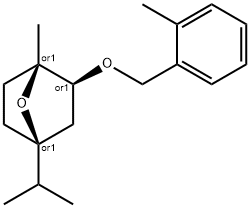
| Product Name: | Cinmethylin | | Synonyms: | 1-Methyl-4-(1-methylethyl)-2-((2-methylphenyl)methoxy)-7-oxabicyclo[2.2.1]heptane;(+-)-exo-1-methyl-4-(1-methylethyl)-2-((2-methylphenyl)methoxy)-7-oxabicyclo;(2.2.1)heptane;1-methyl-4-(1-methylethyl)-2-[(2-methylphenyl)methoxy]-exo-(±)-7-Oxabicyclo[2.2.1]heptane;7-oxabicyclo(2.2.1)heptane,1-methyl-4-(1-methylethyl)-2-((2-methylphenyl)metho;exo-(±)-1-methyl-4-(1-methyl ethyl)-2-((2-methyl phenyl)methoxy)-7-oxabicyclo(2,2,1)heptane;CINMETHYLIN;Cinmethylin mixture of isomers PESTANAL | | CAS: | 87818-31-3 | | MF: | C18H26O2 | | MW: | 274.4 | | EINECS: | 402-410-9 | | Product Categories: | Agro-Products;Aromatics;Herbicide;Heterocycles | | Mol File: | 87818-31-3.mol |
| Cinmethylin Chemical Properties |
| Hazard Codes | Xn,N | | Risk Statements | 20-51/53 | | Safety Statements | 23-61-22 | | RIDADR | UN3082 9/PG 3 | | WGK Germany | 3 | | RTECS | RN8762000 | | HS Code | 29321900 | | Toxicity | LD50 orally in rats: 4.5 g/kg; LD50 dermally in rabbits: >2 g/kg (Lee) |
| Cinmethylin Usage And Synthesis |
| Description | Cinmethylinwas developed by Shell Chemical
Company in the early 1980s as a weed control agent for
monocotyledonous species. This herbicide controls important
grasses such as green foxtail (Setaria viridis) and
barnyardgrass (Echinochloa crus-galli) and suppresses
the growth of several broadleaf weeds such as prickly
sida (Sida spinosa) and velvetleaf (Abutilon theophrasti). | | Uses | Cinmethylin is used as pre-emergence grass herbicide. Cinmethylin is member of the cineole eucalyptol family. | | Uses | Herbicide. | | Pharmacology | Cinmethylin is active on several important grasses in
rice (Echinochloa spp., Cyperus spp., and Monochoria
vaginalis) at rates from 25 to 100 g ai/ha (5). Its chemical
and toxicological features (low persistence in environment
and low mammalian toxicity) generated a significant level
of interest in its use as a rice herbicide. | | Metabolic pathway | When rats are administered 14C-cinmethylin orally, the
major route of its elimination is via urinary excretion. A
complex degradation pattern of cinmethylin is
observed and the metabolic pathways involve
hydroxylation, oxidation at the benzyl and cineol
portions, conjugation with glucuronic acid and glycine,
and cleavage of the ether linkage. When rats are
administered 14C-cinmethylin by stomach incubation,
two minor metabolites are identified as o-
(acetoxymethyl)benzoic acid and 9-(acetoxymethyl)-a-
carboxycinmethylin. |
| Cinmethylin Preparation Products And Raw materials |
|


 日本语
日本语 한국어
한국어 Français
 Deutsch
 España
 Türkiye