Other grades of this product :
| Tolclofos-methyl Basic information |
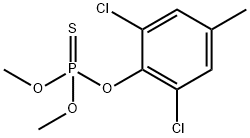
| Product Name: | Tolclofos-methyl | | Synonyms: | 2,6-dichloro-4-methylphenyl o,o-dimethyl phosphorothioate;Dimethyl O-(2,6-dichloro-4-methylphenyl) phosphorothioate;S-3349;RIZOLEX;O-(2,6-DICHLORO-4-METHYLPHENYL) O,O-DIMETHYL PHOSPHOROTHIOATE;TOLCLOFOS-METHYL;Basilex;Dichloro-4-methylphenyl-O,O-dimethyl phosphorothioate | | CAS: | 57018-04-9 | | MF: | C9H11Cl2O3PS | | MW: | 301.13 | | EINECS: | 260-515-3 | | Product Categories: | FUNGICIDE | | Mol File: | 57018-04-9.mol |
| Tolclofos-methyl Chemical Properties |
| Hazard Codes | Xi,N | | Risk Statements | 43-50/53 | | Safety Statements | 22-24/25-61-60-37-24 | | RIDADR | UN 3077 9 / PGIII | | WGK Germany | 3 | | RTECS | TF0460000 | | HS Code | 29201900 | | Hazardous Substances Data | 57018-04-9(Hazardous Substances Data) | | Toxicity | LD50 in male, female rats, male, female mice (mg/kg): ~5000, ~5000, 3500, 3600 orally; all >5000 dermally; ~5000, 4900, 1070, 1260 i.p.; all >5000 s.c. (Ohtsuki, Fujinami) |
| Tolclofos-methyl Usage And Synthesis |
| Uses | Agricultural fungicide. | | Uses | Tolclofos-methyl is a non-systemic organophosphorus fungicide
with both protective and curative activities that control soil-borne diseases
caused by Rhizoctonia solani, Corticium rolfsii, Tphula incamata and Typhula
ishikariensis in/on potatoes, sugar beet, cotton and peanuts. | | Definition | ChEBI: An organic thiophosphate that is 2,6-dichloro-4-methylphenol in which the hydrogen of the hydroxy group group has been replaced by a dimethoxyphosphorothioyl group. Tolclofos-methyl is a phospholipid biosynthesis inhibitor and fungicide that is used for co
trolling soil-borne diseases caused by Typhula incarnata, Corticium rolfsii, Typhula ishikariensis, and Rhizoctonia solani. | | Metabolic pathway | Tolclofos-methyl underwent common degradation and metabolic pathways
in water, soil, plants and animals. These reactions are well
documented for most organophosphorus compounds and include oxidative
desulfuration, hydroxylation/oxidation of the 4-methyl group
to the alcohol and carboxylic acid, cleavage of the P-O-aryl linkage,
O-demethylation and conjugation. In addition to the above reactions,
photolytic isomerisation to the thionate (P=S) was also observed. A
schematic presentation of the primary metabolic pathways for tolclofosmethyl
is illustrated in Scheme 1. | | Degradation | [14C-phenyl]Tolclofos-methyl(1) was stable to hydrolytic degradation at
pH 5, 7 and 9 at 22°C with DT50 values of 139, 417 and 238 days,
respectively. Higher temperature led to a more rapid hydrolysis and two
hydrolysis products were detected. O-Demethylation and oxidative desulfuration
were the major reactions to yield 2,6-dichloro-p-tolyl methyl
hydrogen phosphorothioate (2) and toclofos-methyl oxon (O-2,6-dichlorop-
tolyl O,O-dimethyl phosphate, 3), respectively. Cleavage of the P-O-aryl
linkage yielded 2,6-dichloro-4-methylphenol(4) as a minor degradation
product (WHO, 1994).
Tolclofos-methyl degraded in water under natural sunlight irradiation
with DT50 values of 44 days (in distilled water), 15-28 days (in natural
river and pond water) and less than 2 days in 2% acetone/water. The
major degradation reactions included oxidative desulfuration to yield
compound 3 and O-demethylation to yield compound 2. The major
photodegradation products in river and pond waters and soil thinlayer
surfaces were compounds 2, 3, 4 and the O-demethylated 3 (2,6-
dichloro-p-tolyl methyl hydrogen phosphate, 5) (Mikami et al., 1984).
In acetone solution, demethylation of the isomerisation product [2,6-
dichloro-p-tolyl O,S-dimethyl phosphorothioate (6)] yielded 2,6-dichlorop-
tolyl S-methyl hydrogen phosphorothioate (7) and 2,6-dichloro-p-tolyl
dihydrogen phosphate (8) as the major photodegradates (Mikami et al.,
1984). | | Toxicity evaluation | Its acute oral toxicity is very low in comparison with
a thio-ester type of other organophosphorus fungicides
(edifenphos, iprobenfos, and pyrazophos). |
| Tolclofos-methyl Preparation Products And Raw materials |
|


 日本语
 한국어
 Français
 Deutsch
 España
 Türkiye