Other grades of this product :
| Diethofencarb Basic information |
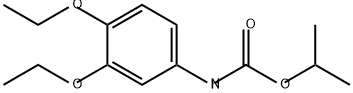
| Product Name: | Diethofencarb | | Synonyms: | Diethofencarb 250mg [87130-20-9];Diethofenacarb;DIETHOFENCARB;(3,4-diethoxyphenyl)-carbamicaci1-methylethylester;1-methylethyl(3,4-diethoxyphenyl)carbamate;Biethofencarb;isopropyl3,4-diethoxycarbanilate;isopropyl3,4-diethoxyphenylcarbamate | | CAS: | 87130-20-9 | | MF: | C14H21NO4 | | MW: | 267.32 | | EINECS: | 403-870-3 | | Product Categories: | FUNGICIDE | | Mol File: | 87130-20-9.mol |
| Diethofencarb Chemical Properties |
| Hazard Codes | Xi | | Risk Statements | 36 | | Safety Statements | 26 | | WGK Germany | 2 | | RTECS | EZ4215700 | | Toxicity | LD50 in male and female rats (mg/kg): >5000, >5000 orally; >5000, >5000 dermally; LC50 (48 hrs) in carp: 13.5 mg/l; (3 hrs) in Daphnia pulex: >10 mg/l (Fujimura, review) |
| Diethofencarb Usage And Synthesis |
| Uses | Diethofenacarb is a pesticide used on crops. It is a fungicide commonly used in China. | | Uses | Agricultural fungicide. | | Uses | Diethofencarb is a systemic carbamate fungicide with both
protective and curative activities used for the control especially
of benzimidazole-resistant strains of fungi, including Botrytis spp.,
Cercosporu spp. and Venturia spp. It is almost ineffective against benzimidazole-
susceptible strains. It is used on vines, cucurbits, tomatoes,
citrus, vegetables and other crops. | | Definition | ChEBI: A carbamate ester that is the isopropyl ester of (3,4-diethoxyphenyl)carbamic acid. A fungicide with strong activity against Botrytis cinerea and benzimidazole-resistant strains of Botryis spp. | | Hazard | Low toxicity by ingestion, inhalation, and
skin contact. | | Metabolic pathway | In aerobic upland soils under laboratory conditions, the
half-life of 14C-diethofencarb is 0.3-6.2 days and the
major metabolite is a nitrated derivative at the
6-position of the phenyl ring. Diethofencarb slowly
degrades under anaerobic upland conditions and
hardly degrades in sterilized soils. |
| Diethofencarb Preparation Products And Raw materials |
|


 日本语
日本语 한국어
한국어 Français
 Deutsch
 España
 Türkiye