Other grades of this product :
| BENFURACARB Basic information |
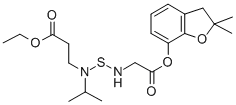
| Product Name: | BENFURACARB | | Synonyms: | oc-11588;ok174;oncol5g;N-(((((2,3-Dihydro-2,2-dimethyl-7-benzofuranyl)oxy)carbonyl)methylamino)thio)-N-(1-methylethyl)-beta-alanine, ethyl ester;2-Methyl-4-(1-methylethyl)-7-oxo-8-oxa-3-thia-2,4-diazadecanoic acid 2,3-dihydro-2,2-dimethyl-7-benzofuranyl ester;Benfuracarb 0;ethyl N-(2,3-dihydro-2,2-dimeyhylbenzofuran-7-yloxycarbonyl(methyl)aminothio)-N-isopropyl-β-alaninate;BENFURACARB PESTANAL, 100 MG | | CAS: | 82560-54-1 | | MF: | C20H30N2O5S | | MW: | 410.53 | | EINECS: | 200-589-5 | | Product Categories: | A-BAlphabetic;Alpha sort;B;BA - BHPesticides;Carbamates;Insecticides;Pesticides&Metabolites | | Mol File: | 82560-54-1.mol |
| BENFURACARB Chemical Properties |
| Melting point | <25℃ | | Boiling point | 110℃ (0.023mmHg) | | density | 1.172 | | vapor pressure | 2.7 x 10⁻⁵ Pa (20 °C) | | refractive index | 1.6510 (estimate) | | Fp | 100 °C | | storage temp. | 0-6°C | | form | neat | | Water Solubility | 8 mg l-1 (20 °C) | | pka | 2.05±0.70(Predicted) | | Specific Gravity | 1.142 (20℃) | | Merck | 13,1039 | | EPA Substance Registry System | Benfuracarb (82560-54-1) |
| Hazard Codes | T,N | | Risk Statements | 23/25-50/53-62-23-22 | | Safety Statements | 36/37-45-60-61 | | RIDADR | 2992 | | WGK Germany | 3 | | RTECS | AY5088000 | | HazardClass | 6.1(b) | | PackingGroup | III | | HS Code | 29329990 | | Toxicity | LD50 in male rats, mice, dogs (mg/kg): 138, 175, 300 orally (Goto) |
| BENFURACARB Usage And Synthesis |
| Chemical Properties | Benfuracarb is a thick liquid. | | Uses | Benfuracarb is a benzofuranyl methylcarbamate based insecticide used to control aphids, springtails and other pests usually on beet crops. | | Uses | Insecticide. | | Uses | Benfuracarb is a contact and ingested insecticide. It is used to control
insect pests in citrus, maize, rice, sugar beet and vegetables. It is active
against Chrysomelidae, Elateridae, Aphididae, Lissorhoptrus oryzophilus
and Plutella xylostella. | | Potential Exposure | A benzofuranyl methylcarbamate
insecticide, nematicide. Not registered for use in the United
States. | | Metabolic pathway | When 14C-benfuracarb is applied topically to
houseflies, the houseflies metabolize benfuracarb
easily to form carbofuran which in turn is oxidized at
the 3-position of the ring and N-methyl group, resulting
in further conjugates of the metabolites. Major
metabolites are carbofuran, 3-hydroxycarbofuran, N-
hydroxymethylcarbofuran, 3-ketocarbofuran, 2,3-
dihydro-2,2-dimethyl-3-hydroxybenzofuran-6-ol, 3-
hydroxy-N-hydroxymethylcarbofuran, and 3-keto-N-
hydroxymethylcarbofuran. | | Shipping | UN 2992 Carbamate pesticides, liquid, toxic,
Hazard Class: 6.1; Labels: 6.1—Poisonous materials. | | Degradation | Benfuracarb is stable in neutral and weakly basic media but unstable in
strongly acidic or basic conditions. It is degraded by sunlight (PM). A
methanolic solution of unlabelled benfuracarb was coated on a glass plate
or applied to soil on a plate and irradiated with a high pressure Hg lamp
(125 W). Details not given were the emission spectrum of the lamp, the
experimental sample temperatures and the irradiation periods. After
irradiation, samples were analysed by TLC methods. The methanol solution
turned a deep brown on irradiation and four major and three minor
products were formed (see Scheme 1). The major products were a cleavage
product (2), the phenol (5) and carbofuran (6). Minor amounts of the
dimeric compounds 3 and 4 were detected. On soil, three photoproducts
were the phenol (5), carbofuran (6) and the cleavage product (7). On a
glass surface four products were the phenol (5), carbofuran (6) and the cleavage products 2 and 7. No products of oxidation were reported (Dureja et al., 1990). | | Incompatibilities | Carbamates are incompatible with reducing
agents, strong acids, oxidizing acids, peroxides, and
bases. Contact with active metals or nitrides cause the
release of flammable, and potentially explosive, hydrogen
gas. May react violently with bromine, ketones.
Incompatible with azo dyes, caustics, ammonia, amines,
boranes, hydrazines, strong oxidizers. | | Waste Disposal | Do not discharge into drains
or sewers. Dispose of waste material as hazardous waste
using a licensed disposal contractor to an approved landfill.
Consult with environmental regulatory agencies for
guidance on acceptable disposal practices. Incineration with
effluent gas scrubbing is recommended. Containers must be
disposed of properly by following package lab el directions
or by contacting your local or federal environmental control
agency, or by contacting your regional EPA office. |
| BENFURACARB Preparation Products And Raw materials |
|


 日本语
日本语 한국어
한국어 Français
 Deutsch
 España
 Türkiye