Other grades of this product :
| 2-HYDROXY-4-(METHYLTHIO)BUTYRIC ACID Basic information |
| 2-HYDROXY-4-(METHYLTHIO)BUTYRIC ACID Chemical Properties |
| 2-HYDROXY-4-(METHYLTHIO)BUTYRIC ACID Usage And Synthesis |
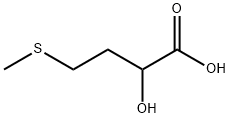
| Uses | Methionine hydroxy analogue | | Uses | 2-Hydroxy-4-(methylthio)butyric Acid is used to improve stem activity to eliminate deoxynivalenol-induced intestinal injury. | | General Description | Light brown liquid. | | Reactivity Profile | An organosulfide, alcohol, and organic acid. Organosulfides are incompatible with acids, diazo and azo compounds, halocarbons, isocyanates, aldehydes, alkali metals, nitrides, hydrides, and other strong reducing agents. Reactions with these materials generate heat and in many cases hydrogen gas. Many of these compounds may liberate hydrogen sulfide upon decomposition or reaction with an acid. Flammable and/or toxic gases are generated by the combination of alcohols with alkali metals, nitrides, and strong reducing agents. They react with oxoacids and carboxylic acids to form esters plus water. Oxidizing agents convert them to aldehydes or ketones. Alcohols exhibit both weak acid and weak base behavior. They may initiate the polymerization of isocyanates and epoxides. Carboxylic acids donate hydrogen ions if a base is present to accept them. They react in this way with all bases, both organic (for example, the amines) and inorganic. Their reactions with bases, called "neutralizations", are accompanied by the evolution of substantial amounts of heat. Neutralization between an acid and a base produces water plus a salt. | | Health Hazard | Corrosive to the eyes and moderately irritating to the skin. |
| 2-HYDROXY-4-(METHYLTHIO)BUTYRIC ACID Preparation Products And Raw materials |
|


 日本语
日本语 한국어
한국어 Français
 Deutsch
 España
 Türkiye