Other grades of this product :
| 3-PHENYLPROPIONITRILE Basic information |
| 3-PHENYLPROPIONITRILE Chemical Properties |
| Melting point | −2-−1 °C(lit.) | | Boiling point | 113 °C9 mm Hg(lit.) | | density | 1.001 g/mL at 25 °C(lit.) | | refractive index | n20/D 1.521(lit.) | | Fp | >230 °F | | storage temp. | Sealed in dry,Room Temperature | | solubility | 1.68g/l (calculated) | | form | Liquid | | Specific Gravity | 1 | | color | Clear colorless to light yellow | | BRN | 636348 | | Exposure limits | NIOSH: IDLH 25 mg/m3 | | CAS DataBase Reference | 645-59-0(CAS DataBase Reference) | | EPA Substance Registry System | Benzenepropanenitrile (645-59-0) |
| Hazard Codes | T,C | | Risk Statements | 23/24/25-36-34 | | Safety Statements | 36/37/39-45-27-26 | | RIDADR | UN 3276 6.1/PG 3 | | WGK Germany | 3 | | RTECS | MW5604750 | | TSCA | Yes | | HazardClass | 6.1 | | PackingGroup | II | | HS Code | 29269095 |
| 3-PHENYLPROPIONITRILE Usage And Synthesis |
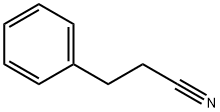
| Chemical Properties | clear colorless to light yellow liquid | | Uses | A glucosinolate enzymic hydrolosis product with potential antibacterial activities against plant pathogenic bacteria | | Uses | 3-Phenylpropionitrile was used to study the free enzyme activity of nitrilase AtNIT1. | | Definition | ChEBI: A nitrile that is propionitrile in which one of the methyl hydrogens has been replaced by a phenyl group. | | Preparation | To a stirred solution of 3-phenylpropanamide (50 mg, 0.34 mmol) in acetonitrile (0.8 mL) at room temperature were successively added formic acid (0.2 mL) and paraformaldehyde (50 mg, 1.67 mmol). The reaction mixture was then refluxed for 12 h, and the solution obtained was cooled to room temperature. Work-up A: The crude mixture was concentrated under reduced pressure, and the residue was subjected to flash chromatography on silica gel (230–240 mesh) eluting with hexane/ethyl acetate (7:3) to yield 3-phenylpropanonitrile (37 mg, 85%). Work-up B: The reaction mixture was diluted with ethyl acetate (10 mL) and washed successively with saturated sodium hydrogen carbonate solution (5 mL) and water (5 mL). The combined aqueous layers were extracted with ethyl acetate (2 × 10 mL). The combined organic layers were dried over Na2SO4, filtered, and concentrated. The crude 3-phenylpropanonitrile was purified as described above (Work-up A). | | Synthesis Reference(s) | Journal of the American Chemical Society, 98, p. 4685, 1976 DOI: 10.1021/ja00431a078Chemical and Pharmaceutical Bulletin, 10, p. 427, 1962 DOI: 10.1248/cpb.10.427 | | General Description | The effect of 3-Phenylpropionitrile on the growth and survival of woodlouse Porcellio scaber has been studied. |
| 3-PHENYLPROPIONITRILE Preparation Products And Raw materials |
|


 日本语
日本语 한국어
한국어 Français
 Deutsch
 España
 Türkiye