Other grades of this product :
| Pyraclofos Basic information |
| Pyraclofos Chemical Properties |
| Hazard Codes | Xi,Xn | | Risk Statements | 22 | | RIDADR | 3018 | | RTECS | TE8346000 | | HazardClass | 6.1(b) | | PackingGroup | III | | HS Code | 29331990 |
| Pyraclofos Usage And Synthesis |
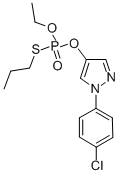
| Uses | Pyraclofos is used to control Lepidoptera, Coleoptera, mites and
nematodes in fruit, vegetables, ornamentals and forestry. It has also been
used in a human health application to control filarial worms. | | Metabolic pathway | Pyraclofos is apparently subjected in insects to a metabolic activation to
yield a more active acetylcholinesterase inhibitor which is possibly a
thiooxidized metabolite. The compound is very rapidly degraded in
mammals to inactive metabolites via P-O-aryl, P-O-alkyl and P-S-alkyl
cleavage which explains its favourable selective toxicity. In both mammals
and plants the principal degradative route is via P-O-aryl cleavage to
give 1-(4-chlorophenyl)-4-hydroxypyrazolwe hich is rapidly conjugated. | | Metabolism | Pyraclofos
is metabolized to an active AChE inhibitor, probably by
the oxidation of the sulfur atom in the phosphorothiolate
linkage. The half-life in soil is 3–38 d, depending on
soil type. | | Toxicity evaluation | The acute oral LD50 for
rats is 237 mg/kg. The inhalation LC50 for rats is
1.69 mg/L air. NOEL (2 yr) for rats is 0.10–0.12 mg/kg
diet (0.005–0.006 mg/kg/d). Pyraclofos administered to
rats is rapidly degraded, and more than 90% of the
dose is excreted principally in the urine within 24 h. The
degradation routes are cleavages of the P?S, P?O-alkyl,
and P?O-aryl bonds in both animals and plants. | | Degradation | The DT50 for hydrolysis in water at pH 7 (25 °C) was 29 days (PM). |
| Pyraclofos Preparation Products And Raw materials |
|


 日本语
日本语 한국어
한국어 Français
 Deutsch
 España
 Türkiye