Other grades of this product :
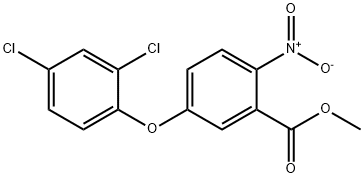
| Bifenox Basic information |
| Bifenox Chemical Properties |
| Hazard Codes | N | | Risk Statements | 50/53 | | Safety Statements | 60-61 | | RIDADR | UN 3077 9/PG 3 | | WGK Germany | 2 | | RTECS | DG7890000 | | HS Code | 29189900 | | Hazardous Substances Data | 42576-02-3(Hazardous Substances Data) | | Toxicity | LD50 orally in rats, mice: >6400, 4556 mg/kg; LC50 in pheasants, wild ducks: >5000 ppm (Kruger) |
| Bifenox Usage And Synthesis |
| Uses | Herbicide. | | Uses | Selective preemergence or postemergence herbicide used to effectively control a wide variety of broad-leaved weeds (such as bindweed, jimsonweed, kochia, mustards, pigweeds, sesbania, smartweed and velvet-leaf) in tolerant crops (corn, grain sorghum, maize, rice and soybeans). | | Agricultural Uses | Herbicide: Used to control a variety of broadleaf weeds and
grasses in legumes such as soybeans and peanuts, and
post-emergent weed control in wheat, barley and sugar
beets. Not currently registered in the U.S. However, it is
used in 21 European countries and there are 27 global
suppliers. | | Trade name | ALIBI®; FOX®; MODOWN®[C]; MC-
4379®; SABINE® | | Environmental Fate | Soil. Bifenox degrades in soil forming 5-(2,4-dichlorophenoxy)-2-nitrobenzoic acid
and methyl 5-(2,4-dichlorophenoxy)anthranilate (Hartley and Kidd, 1987; Smith 1988).
The average half-life in soils is 7–14 days (Hartley and Kidd, 1987; Humburg et al., 1989)Plant. Rapidly undergoes ring hydroxylation and subsequent conjugation in rice plants
(Ashton and Monaco, 1991).Photolytic. The UV photolysis (λ = 300 nm) of bifenox in various solvents was studied
by Ruzo et al. (1980). In water, 2,4-dichloro-3′-(carboxymethyl)-4′-hydroxydiphenyl ether
and 2,4-dichloro-3′-(carboxymethyl)-4′-aminodiphenyl ether were identi |
| Bifenox Preparation Products And Raw materials |
|


 日本语
日本语 한국어
한국어 Français
 Deutsch
 España
 Türkiye