Other grades of this product :
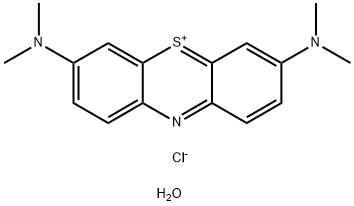
| Methylene Blue trihydrate Basic information |
| Methylene Blue trihydrate Chemical Properties |
| Melting point | 190 °C (dec.)(lit.) | | density | 0.98 g/mL at 25 °C | | Fp | 14 °C | | storage temp. | no restrictions. | | solubility | Soluble in water, chloroform; sparingly soluble in ethanol | | form | Solid | | pka | 2.6, 11.2(at 25℃) | | Colour Index | 52015 | | color | Green | | Water Solubility | 4 g/100 mL | | λmax | 668 nm, 609 nm | | Merck | 13,6085 | | Stability: | Stable. Incompatible with bases, reducing agents, strong oxidizing agents. | | Biological Applications | Diagnosis of tauopathy,Alzheimer’s disease (AD),Pick’s disease; treating prophylaxis; dental materials | | InChIKey | YAFGUSOAMIMROI-UHFFFAOYSA-M | | CAS DataBase Reference | 7220-79-3(CAS DataBase Reference) | | IARC | 3 (Vol. 108) 2016 | | EPA Substance Registry System | Methylene blue trihydrate (7220-79-3) |
| Methylene Blue trihydrate Usage And Synthesis |
| Chemical Properties | Dark green crystalline powder | | Uses | antibacterial | | Uses | Stain in bacteriology; reagent for several chemicals; as mixed indicator; as redox colorimetric agent. Targeting agent for melanoma. | | Uses | Methylene Blue trihydrate finds many uses in biology and chemistry. It acts as a GCS inhibitor, biological stain and redox indicator. It inhibits tau filament formation. Further, it is reported to bind to the M2 subtype of muscarinic receptors in rat cardiac myocytes and thus exhibit antimuscarinic effects on IK, ACh and ICa. It also inhibits endothelium-dependent relaxation of isolated blood vessels. | | Application | Methylene blue is not an officially restricted drug. It is mainly used to control water mildew and small melon insects. It can replace malachite green. Methylene blue dissolved in water does little harm to fish. In addition, the drug has made achievements in many fields such as industry, medicine and skin care. Even the drug will be applied to more difficult cancer diseases. Methylene blue is more effective in the treatment of non advanced fish diseases. Methylene blue is an oxidant, which can oxidize nitrite into nitrate, inhibit and kill bacteria. However, it also has a certain impact on nitrifying bacteria, so some measures should be taken after use.
Methylene blue can be used in the manufacture of ink and lakes and the dyeing of biological and bacterial tissues. It can be used for dyeing cotton, hemp, silk fabrics, paper and bamboo and wood. It can also be mixed with crystal violet and yellow dextrin in the ratio of 78:13:9 to form alkaline magenta blue. | | General Description | Odorless or almost odorless dark green crystals with bronze luster or dark green crystalline powder. pH (1% solution in water) 3 to 4.5 . | | Air & Water Reactions | Hygroscopic. Water soluble. Gives a blue solution in water. | | Reactivity Profile | Methylene Blue trihydrate is incompatible with strong oxidizing agents, caustics, alkali metal iodides and reducing agents. Also incompatible with dichromates. Methylene Blue trihydrate forms double salts with many inorganic salts. Is bleached reversibly by (zinc + hydrochloric acid) or sodium hydrosulfite. In aqueous solution, Methylene Blue trihydrate is decolorized by zinc dust and dilute sulfuric acid, but the color is restored upon exposure to air and more rapidly upon addition of ammonium hydroxide. | | Fire Hazard | Flash point data for Methylene Blue trihydrate are not available; however, Methylene Blue trihydrate is probably combustible. |
| Methylene Blue trihydrate Preparation Products And Raw materials |
|


 日本语
日本语 한국어
한국어 Français
 Deutsch
 España
 Türkiye