Other grades of this product :
| SUBSTANCE P Basic information |
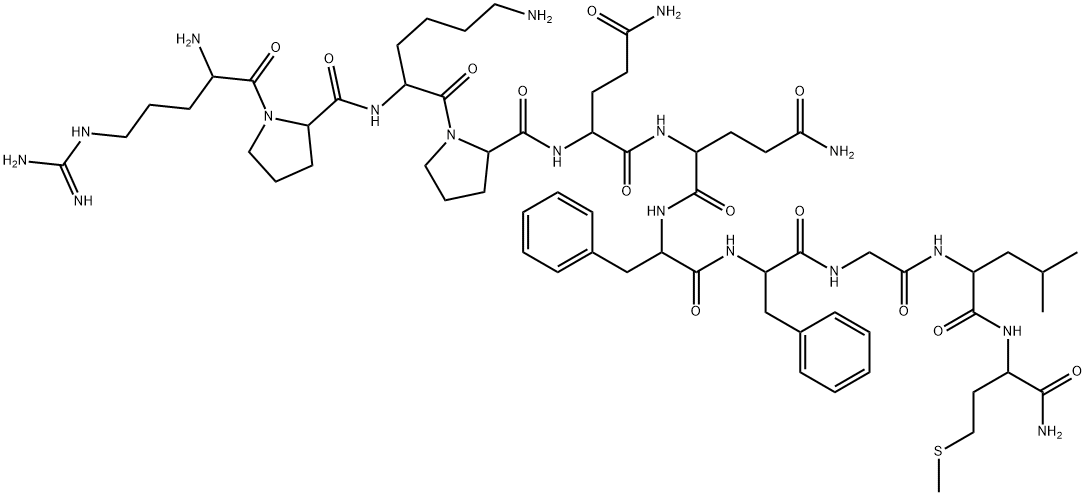
| Product Name: | SUBSTANCE P | | Synonyms: | ARG-PRO-LYS-PRO-GLN-GLN-PHE-PHE-GLY-LEU-MET-NH2;H2N-ARG-PRO-LYS-PRO-GLN-GLN-PHE-PHE-GLY-LEU-MET;H-ARG-PRO-LYS-PRO-GLN-GLN-PHE-PHE-GLY-LEU-MET-NH2;SUBSTANCE P, F & D VERSION OF S6883*ACET ATE;(2S)-2-[[(2S)-1-[(2S)-6-amino-2-[[(2S)-1-[(2S)-2-amino-5-(diaminomethylideneamino)pentanoyl]pyrrolidine-2-carbonyl]amino]hexanoyl]pyrrolidine-2-carbonyl]amino]-N-[(2S)-5-amino-1-[[(2S)-1-[[(2S)-1-[[2-[[(2S)-1-[[(2S)-1-amino-4-methylsulfanyl-1-oxobutan-2-yl]amino]-4-methyl-1-oxopentan-2-yl]amino]-2-oxoethyl]amino]-1-oxo-3-phenylpropan-2-yl]amino]-1-oxo-3-phenylpropan-2-yl]amino]-1,5-dioxopentan-2-yl]pentanediamide;SUBSTANCE P (HUMAN, BOVINE, RAT, MOUSE);SUBSTANCE P BOVINE;SUBSTANCE P, [D-ARG1, D-PRO2, D-TRP7,9, LEU11] | | CAS: | 33507-63-0 | | MF: | C63H98N18O13S | | MW: | 1347.63 | | EINECS: | 251-545-8 | | Product Categories: | Peptide;Tachykinin receptor;TPI;Peptide Receptors | | Mol File: | 33507-63-0.mol |
| SUBSTANCE P Chemical Properties |
| Melting point | 148 °C | | density | 1.42±0.1 g/cm3(Predicted) | | storage temp. | −20°C | | solubility | H2O: 1 mg/mL | | pka | 13.26±0.46(Predicted) | | form | powder | | color | white | | Water Solubility | Soluble in water, DMSO, and Acetic Acid. |
| SUBSTANCE P Usage And Synthesis |
| Uses | Substance P is a neurokinin undecapeptide neurotransmitter and neuromodulator. | | General Description | Substance P is a polypeptide consisting of 11 amino acidresidues. It has been implicated in the transmission of“painful” sensory information through the spinal cord tohigher centers in the central nervous system. Substance Pis localized in the primary afferent sensory fibers. Other pharmacologicaleffects are vasodilatation, stimulation of smoothmuscles, stimulation of salivary secretion, and diuresis. In addition,this neuropeptide contributes to some inflammatory responses.Approximately 50% of the known neuropeptides aresynthesized as biologically inactive glycine extended precursorsthat require a carboxy-terminal posttranslational amidationfor biological activity. Amidation enzymes are responsiblefor the conversion of the carboxyl group of the neuropeptide tothe corresponding amide group and include the two amidatingenzymes peptidylglycine α-monooxygenase (PAM) and peptidylamidoglycolatelyase (PGL), which work sequentially toproduce the inflammatory neuropeptide Substance P from aninactive precursor peptide. Much research is being performedto exploit this mechanism of inflammation. |
| SUBSTANCE P Preparation Products And Raw materials |
|


 日本语
日本语 한국어
한국어 Français
 Deutsch
 España
 Türkiye