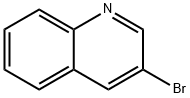
| 3-Bromoquinoline Basic information |
| Bromoquinoline Application and synthesis method Uses |
| Product Name: | 3-Bromoquinoline |
| Synonyms: | 3-bromo-quinolin;3-BROMOQUINLIINE;3-BROMOQUINOLINE;Bromoquinoline;Quinoline, 3-bromo-;3-Bromoquinoline98%Or99%;3-Bromoquinoline 98 %;3-Bromoquinoline ,98% [HPLC 98%] |
| CAS: | 5332-24-1 |
| MF: | C9H6BrN |
| MW: | 208.05 |
| EINECS: | 226-237-1 |
| Product Categories: | Aromatics Compounds;Haloquinolines;Quinoline&Isoquinoline;Quinoline Derivertives;Aromatics;Building Blocks;blocks;Bromides;Halides;Heterocycles;Quinolines, Quinazolines and derivatives;Halogenated Heterocycles;Heterocyclic Building Blocks;QuinolinesHeterocyclic Building Blocks;Quinolines |
| Mol File: | 5332-24-1.mol |
| 3-Bromoquinoline Chemical Properties |
| Melting point | 13-15 °C (lit.) |
| Boiling point | 274-276 °C (lit.) |
| density | 1.533 g/mL at 25 °C (lit.) |
| vapor pressure | 0.196Pa at 25℃ |
| refractive index | n |
| Fp | >230 °F |
| storage temp. | Keep in dark place,Inert atmosphere,Room temperature |
| pka | 2.69(at 25℃) |
| form | Liquid |
| color | Clear colorless to yellow |
| Water Solubility | 103mg/L at 25℃ |
| BRN | 112939 |
| InChIKey | ZGIKWINFUGEQEO-UHFFFAOYSA-N |
| LogP | 3.03 |
| CAS DataBase Reference | 5332-24-1(CAS DataBase Reference) |
| NIST Chemistry Reference | Quinoline, 3-bromo-(5332-24-1) |
| EPA Substance Registry System | Quinoline, 3-bromo- (5332-24-1) |
| Safety Information |
| Hazard Codes | Xi |
| Risk Statements | 36/37/38 |
| Safety Statements | 26-36-37/39 |
| RIDADR | UN2810 |
| WGK Germany | 3 |
| TSCA | Yes |
| HS Code | 29334900 |
| MSDS Information |
| Provider | Language |
|---|---|
| 3-Bromoquinoline | English |
| ACROS | English |
| SigmaAldrich | English |
| ALFA | English |
| 3-Bromoquinoline Usage And Synthesis |
| Bromoquinoline | There are seven position isomers with the main properties are as follows:
▼ ▲ Name
Melting point(℃)
Boiling point(℃)
Solubility
2-bromoquinoline
48~49
It is soluble in diethyl ether, chloroform and benzene
3-bromoquinoline
12~15
274~276,
95(66.66Pa)
4-bromoquinoline
29~30
270(decomposition)
Easily soluble in dilute acid
5-bromoquinoline
52 (needle crystal)
280
6-bromoquinoline
24
278
7-bromoquinoline
52 (needle crystal)
290
8-bromoquinoline
80
165~166
(2399.79Pa)
|
| Application and synthesis method | 3-Bromoquinoline can have action with mixed acid to generate 3-bromo-5-nitroquinoline, followed by heating with potassium permanganate to be oxidized to 5-bromo-2, 3-pyridine dicarboxylic acid. 6-bromo-quinoline can be heated together nitric acid to generate 6-bromo-8-nitro-quinoline, followed by reaction with potassium permanganate to be oxidized into 2, 3-pyridinedicarboxylic acid. 2-bromo-quinoline can be manufactured through the reaction between 2-hydroxyquinoline and phosphorus pentabromide 3-bromo-quinoline can be obtained through heating the quinoline perbromide at 180 ° C. 4-bromoquinoline can be obtained through either the heating reaction between 4-hydroxyquinoline and phosphorus pentabromide or by the diazotization reaction of 4-aminoquinoline. 5-bromo-quinoline can be obtained from the heating reaction between m-bromo aniline, glycerol, m-bromonitrobenzene and concentrated sulfuric acid, or through the diazotization reaction of 5-amino-quinoline. 6-bromo-quinoline can be obtained through the heating reaction between p-bromoaniline, glycerol, concentrated sulfuric acid and p-bromo-nitrobenzene. 7-bromoquinoline can be obtained through the diazotization of 7-aminoquinoline. 8-bromo-quinoline can be obtained through the heating of o-bromo aniline, glycerol, concentrated sulfuric acid and o-bromo-nitrobenzene in the heating system. Purposes: as organic synthesis reagents. |
| Uses | For pharmaceuticals Medicine, pesticide intermediates |
| Chemical Properties | colorless to light yellow liquid |
| Synthesis Reference(s) | The Journal of Organic Chemistry, 27, p. 1318, 1962 DOI: 10.1021/jo01051a047 |
| General Description | 3-Bromoquinoline undergoes bromine-magnesium exchange reaction with lithium tributylmagnesate in toluene at -10°C, which is quenched by various electrophiles to yield functionalized quinolines. |
| Flammability and Explosibility | Notclassified |
| 3-Bromoquinoline Preparation Products And Raw materials |
Please leave a message for us or use the following ways to contact us, we will reply to you as soon as possible, and provide you with the most sincere service, thank you.


 日本语
日本语 한국어
한국어 Français
 Deutsch
 España
 Türkiye