Other grades of this product :
| Crisaborole Basic information |
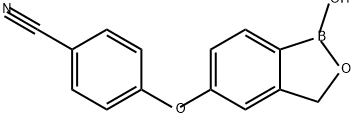
| Product Name: | Crisaborole | | Synonyms: | 4-[(1,3-Dihydro-1-hydroxy-2,1-benzoxaborol-5-yl)oxy]benzonitrile AN 2728;AN-2728, >=98%;AN2728, Crisaborole;Crisaborole (AN2728);AN 2728;AN2728/AN-2728;4-((1-Hydroxy-1,3-dihydrobenzo-[c][1,2]oxaborol-5-yl)oxy)benzonitrile;4-[(1,3-Dihydro-1-hydroxy-2,1-benzoxaborol-5-yl)oxy]benzonitrile | | CAS: | 906673-24-3 | | MF: | C14H10BNO3 | | MW: | 251.05 | | EINECS: | | Product Categories: | API | | Mol File: | 906673-24-3.mol |
| Crisaborole Chemical Properties |
| Melting point | >130°C (softened) | | Boiling point | 425.9±55.0 °C(Predicted) | | density | 1.33±0.1 g/cm3(Predicted) | | storage temp. | room temp | | solubility | DMSO (Slightly), Methanol (Slightly) | | form | powder | | pka | 7.00±0.20(Predicted) | | color | white to beige |
| Crisaborole Usage And Synthesis |
| Description | Crisaborole is a phosphodiesterase-
4 (PDE4) inhibitor that was approved by the USFDA for
the treatment of mild to moderate atopic dermatitis (AD) in
patients aged two years and older. The drug, which was
developed by Anacor Pharmaceuticals and later acquired and
marketed by Pfizer, is delivered as a 2% ointment, which is applied topically. The unique employment of boron within
the chemical structure of the drug is designed to enable
selective engagement of PDE4 (an enzyme involved in the
conversion of cAMP into AMP, which signals for downstream
inflammatory events), effective penetration of the drug through
human skin, and rapid clearance to limit systemic circulation. | | Description | AN2728 is a boron-based, topical anti-inflammatory agent that inhibits phosphodiesterase 4 (PDE4; IC50 = 0.11 μM). It is less potent against PDE1A, PDE3A, and PDE7A (IC50s = 6.12, 6.41, and 0.73 μM, respectively). AN2728 suppresses the release of the proinflammatory cytokines TNF-α, IL-2, INF-γ, IL-5, and IL-10 with IC50 values of 0.50, 0.59, 0.72, 2.25, and 2.58 μM, respectively. | | Uses | A series of phenoxy benzoxaboroles were synthesized and screened for their inhibitory activity against PDE4 and cytokine release. 5-?(4-?Cyanophenoxy)?-?2,?3-?dihydro-?1-?hydroxy-?2,?1-?benzoxaborole (AN2728) showed potent activity both in vitro and in vivo. AN2728 is being studied as an anti-inflammatory agent. | | Biochem/physiol Actions | Crisaborole is a non-steroidal anti-inflammatory phosphodiesterase 4 (PDE4) inhibitor. Crisaborole has an IC50 value of 490 nM for PDE4 with similar IC50 values for release of cytokines TNF-α, IL-2, and IFN-γ, and shows little inhibition against other PDE isozymes. Crisaborole has been approved as a topical treatment for atopic dermatitis. | | Synthesis | Several disclosures describing synthetic approaches to
ethereal boron-containing anti-inflammatory compounds have
been published by Anacor. Commercially available bromobenzaldehyde
134 was protected as the corresponding acetal upon
subjection to warm ethylene glycol in the presence of catalytic
p-toluenesulfonic acid. This was followed by nucleophilic
aromatic substitution involving 4-fluorobenzonitrile and subsequent
acetal deprotection to furnish diaryl ether 136.
Although multiple approaches to crisaborole have been
reported from this intermediate diaryl ether 136, the
published literature approach involves the following sequence:
reduction of the aldehyde with sodium borohydride followed
by THP protection to furnish bromobenzene 137, which then
underwent lithium-halogen exchange prior to quenching with
triisopropyl borate and acidification to arrive at crisaborole
(XIII). Alternatively, patents from Anacor describe a general
approach employing a Miyaura coupling of 136, enabling the
installation of the corresponding pincacol borane, which could
then be exposed to reduction conditions using sodium
borohydride followed by boric acid wash, aqueous workup,
and lyophilization to furnish XIII. |
| Crisaborole Preparation Products And Raw materials |
|


 日本语
日本语 한국어
한국어 Français
 Deutsch
 España
 Türkiye