Other grades of this product :
| o-Phenanthroline Basic information |
| o-Phenanthroline Chemical Properties |
| Melting point | 114-117 °C(lit.) | | Boiling point | >330°C | | density | 1.1836 (rough estimate) | | refractive index | 1.5200 (estimate) | | Fp | >330°C | | storage temp. | Store below +30°C. | | solubility | 2.69g/l | | pka | 4.84(at 25℃) | | form | Powder | | color | White to light yellow or light pink | | Water Solubility | slightly soluble | | Sensitive | Hygroscopic | | Merck | 14,7214 | | BRN | 126461 | | Stability: | Stable. Hygroscopic. Store under nitrogen. Incompatible with strong acids, strong oxidizing agents. | | InChIKey | DGEZNRSVGBDHLK-UHFFFAOYSA-N | | CAS DataBase Reference | 66-71-7(CAS DataBase Reference) | | NIST Chemistry Reference | o-Phenanthroline(66-71-7) | | EPA Substance Registry System | 1,10-Phenanthroline (66-71-7) |
| Hazard Codes | T,N | | Risk Statements | 25-50/53 | | Safety Statements | 45-60-61 | | RIDADR | UN 2811 6.1/PG 3 | | WGK Germany | 3 | | RTECS | SF8437000 | | TSCA | Yes | | HazardClass | 6.1 | | PackingGroup | III | | HS Code | 29339990 | | Toxicity | dni-hmn:leu 5 mg/L ONCOBS 46,193,89 |
| o-Phenanthroline Usage And Synthesis |
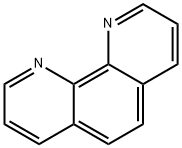
| Description | o-Phenanthroline is an organic intermediate, white crystalline powder. It is a redox indicator, a reagent for the determination of ferrous, palladium, vanadium, copper and iron. | | Chemical Properties | off-white powder | | Characteristics | o-Phenanthroline can form complexes with a variety of transition metals. Since the complexes formed are chelates, they are relatively stable. The complexes and their derivatives formed with copper can be used as non-oxidative nucleic acid cleaving enzymes because they have certain cleavage activity on DNA, and further have certain anticancer activities. | | Uses | A chelating agent, forming complexes with most metal ions. | | Uses | A ligand employed in the spectrophotometric determination of metals and photocatalytic reduction of carbon dioxide. | | Uses | As an analytical reagent for determination of metals in chemical and biological systems through complex formation. As an indicator ("Ferroin") in combination with ferrous ions for oxidation/reduction reactions. In organic syntheses as an activator. | | Safety Profile | Poison by ingestion and intraperitoneal routes. An experimental teratogen. Mutation data reported. When heated to decomposition it emits toxic fumes of NOx. | | in vitro | proteolysis of lamins, which are the intermediate filament proteins providing support to the nuclear structural proteins and are targets of mmp-2, o-phenanthroline abolished the proteolysis of lamin a [2]. | | Purification Methods | Purify it via the HgCl2 addition compound formed when phenanthridine (20g) in 1:1 HCl (100mL) is added to aqueous HgCl2 (60g in 3L), and the mixture is heated to boiling. The HgCl2 complex separates as yellow red crystals with m 195-198o [Arcus & Mesley J Chem Soc 1780 1953]. Conc HCl is then added until all of the solid has dissolved. The compound separates on cooling and is decomposed with aqueous NaOH (ca 5M). Phenanthridine is extracted into Et2O, evaporated, and the residue is crystallised from pet ether (b 80-100o) or EtOAc. [Cumper et al. J Chem Soc 45218 1962.] It is also purified by chromatography on activated alumina from *benzene solution, with diethyl ether as eluent. Evaporation of ether gives crystalline material which is freed from residual solvent under vacuum, then further purified by fractional crystallisation, under N2, from its melt. It was purified by zone melting and sublimes in a vacuum. The picrate has m 218.5-219.5o (from iso-PrOH) (also reported are m 244-245o and 247-248o, from EtOH or H2O). [Slough & Ubbelhode J Chem Soc 911 1957.] [Beilstein 20 H 466, 20 III/IV 4016, 20/8 V 223.] |
| o-Phenanthroline Preparation Products And Raw materials |
| Raw materials | o-Phenylenediamine-->8-Aminoquinoline-->1,10-Phenanthroline, 1,2,3,4-tetrahydro--->Pyridine, 3,3'-(1Z)-1,2-ethenediylbis[2-bromo--->2-Amino-3-pyridinecarboxaldehyde-->5 6-EPOXY-5 6-DIHYDRO-(1 10)PHENANTHROL&-->Disodium succinate | | Preparation Products | 1 10-PHENANTHROLINE-5 6-DIONE 97-->2,9-dibromo-1,10-phenanthroline-5,6-dione-->SODIUM 2,4-PENTANEDIONATE-->1,10-Phenanthroline-5,6-dione,3,8-dibromo-->5,6-Dimethyl-1,10-phenanthroline-->2-Methoxybenzyl alcohol-->2,2'-BICINCHONINIC ACID-->2,9-Dichloro-1,10-phenanthroline |
|


 日本语
日本语 한국어
한국어 Français
 Deutsch
 España
 Türkiye