Other grades of this product :
| (L-3-TRANS-CARBOXYOXIRANE-2-CARBONYL)-L-LEUCYLAGMATINE HEMIHYDRATE Basic information |
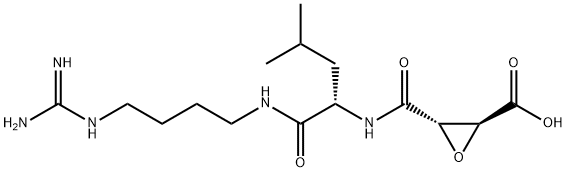
| Product Name: | (L-3-TRANS-CARBOXYOXIRANE-2-CARBONYL)-L-LEUCYLAGMATINE HEMIHYDRATE | | Synonyms: | (2S,3S)-3-(((S)-1-((4-Guanidinobutyl)amino)-4-methyl-1-oxopentan-2-yl)carbamoyl)oxirane-2-carboxylic acid;(2S,3S)-3-(((S)-1-((4-Guanidinobutyl)amino)-4-methyl-1-oxopentan-2-yl)carbamoyl)oxirane-2-carb;oxiranecarboxylicacid,3-(((1-(((4-((aminoiminomethyl)amino)butyl)amino)carbon;proteinaseinhibitore64;thiolproteaseinhibitor;TRANS-EPOXYSUCCINYL-L-LEUCYLAMIDO-*(4-GU ANIDINO)BUT;(2S, 3S)-TRANS-EPOXY SUCCINYL-L-LEUCYLAMIDO-(4-GUANIDINO) BUTANE;L-TRANS-3-CARBOXYOXIRAN-2-CARBONYL-L-LEUCYLAGMATINE | | CAS: | 66701-25-5 | | MF: | C15H27N5O5 | | MW: | 357.41 | | EINECS: | 613-978-4 | | Product Categories: | Pepetides;ProteaseInhibitors;peptides;inhibitor;Inhibitors | | Mol File: | 66701-25-5.mol |
| (L-3-TRANS-CARBOXYOXIRANE-2-CARBONYL)-L-LEUCYLAGMATINE HEMIHYDRATE Chemical Properties |
| Melting point | >170°C (dec.) | | density | 1.44±0.1 g/cm3(Predicted) | | storage temp. | 2-8°C | | solubility | H2O: 20 mg/mL, clear, colorless | | pka | 3.16±0.40(Predicted) | | form | White solid | | color | White or off-white | | Water Solubility | Soluble in DMSO (25mg/ml), or water (20mg/ml) | | Sensitive | Light Sensitive | | BRN | 1405664 | | Stability: | Stable for 1 year from date of purchase as supplied. | | InChIKey | LTLYEAJONXGNFG-DCAQKATOSA-N | | CAS DataBase Reference | 66701-25-5(CAS DataBase Reference) |
| Safety Statements | 22-24/25 | | WGK Germany | 3 | | RTECS | RR0390000 | | F | 10 | | HS Code | 29252900 |
| (L-3-TRANS-CARBOXYOXIRANE-2-CARBONYL)-L-LEUCYLAGMATINE HEMIHYDRATE Usage And Synthesis |
| Description | E-64 (66701-25-5) is a cell-permeable, epoxysuccinyl peptide irreversible inhibitor of calpain and other cysteine proteases.1,2?Inhibits calpain-dependent apoptosis pathway in T cells3?but promotes heat-induced apoptosis in FM3A cells. Typical working concentration is 0.5-10 μg/ml.4 | | Uses | It is used as a broad spectrum cysteine proteinase and calpain activation inhibitor. Additionally, Prevotella intermediate studies report that E-64 blocks the breakdown of methaemoglobin and the oxidation of oxyhaemoglobin by InpA. E-64 has also been used to study excystation in Giardia lamblia. E-64 is an inhibitor of Calpain, cathepsin K and cathepsin S. E-64 is an effective ligand for affinity purification of cysteine proteases. When coupled to a thiolated affinity matrix, binding is no longer irreversible, but specificity is retained | | General Description | E-64 is a cysteine protease inhibitor that was isolated from the mold Aspergillus japonicus TPR-64. E-64 is also known as N-[N-(L-3-trans-carboxyoxiran-2-carbonyl)-L-leucyl]-agmatine. E-64 effectively inhibits various cysteine proteases, in particular:- cathepsin K
- cathepsin L
- cathepsin S
E-64 also acts against other enzymes, such as:- calpain
- cathepsin B
- cathepsin H
- papain
| | Hazard | A reproductive hazard. | | Biochem/physiol Actions | E-64 is an irreversible, potent, and highly selective cysteine protease inhibitor. E-64 does not react with the functional thiol group of non-protease enzymes, such as L-lactate dehydrogenase or creatine kinase. E-64 will not inhibit serine proteases (except trypsin) like other cysteine protease inhibitors, leupeptin and antipain. The trans-epoxysuccinyl group (active moiety) of E-64 irreversibly binds to an active thiol group in many cysteine proteases, such as papain, actinidase, and cathepsins B, H, and L to form a thioether linkage. E-64 is a very useful cysteine protease inhibitor for use in in vivo studies because it has a specific inhibition, it is permeable in cells and tissues and has low toxicity. | | References | 1) Wang and Yuen (1994),?Calpain inhibition: an overview of its therapeutic potential; Trends Pharmacol. Sci.,?15?412
2) Barrett?et al.?(1982),?L-trans-Epoxysuccinyl-leucylamido(4-guanidino)butane (E-64) and its analogues as inhibitors of cysteine proteinases including cathepsins B, H, and L; Biochem. J.,?201?189
3) Sarin?et al.?(1994),?Inhibition of activation-induced programmed cell death and restoration of defective immune responses of HIV+ donors by cysteine protease inhibitors; J. Immunol.,?153?862
4) Zhu?et al.?(1996),?Promotion of heat-induced apoptosis in FM3A cells by protease inhibitors; Biochem. Biophys. Res. Commun.,?225?924 |
| (L-3-TRANS-CARBOXYOXIRANE-2-CARBONYL)-L-LEUCYLAGMATINE HEMIHYDRATE Preparation Products And Raw materials |
|


 日本语
日本语 한국어
한국어 Français
 Deutsch
 España
 Türkiye