Other grades of this product :
| 2,6-DICHLORO-1,4-BENZOQUINONE Basic information |
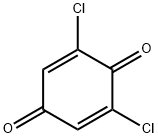
| Product Name: | 2,6-DICHLORO-1,4-BENZOQUINONE | | Synonyms: | LABOTEST-BB LT00159342;2,6-DICHLORO-1,4-BENZOQUINONE;2,6-DICHLORO-P-QUINONE;2,6-DICHLORO-P-BENZOQUINONE;2,6-Dichloquinone;2,6-Dichloro-2,5-cyclohexa-diene-1,4-dione;2,6-dichloro-2,5-cyclohexadiene-1,4-dione;2,6-Dichlorobenzo-1,4-quinone | | CAS: | 697-91-6 | | MF: | C6H2Cl2O2 | | MW: | 176.98 | | EINECS: | 211-810-0 | | Product Categories: | Anthraquinones, Hydroquinones and Quinones;Benzoquinones;C3 to C6;Carbonyl Compounds;Ketones | | Mol File: | 697-91-6.mol |
| 2,6-DICHLORO-1,4-BENZOQUINONE Chemical Properties |
| Melting point | 122-124 °C(lit.) | | Boiling point | 251.81°C (rough estimate) | | density | 1.5138 (rough estimate) | | refractive index | 1.4595 (estimate) | | storage temp. | Hygroscopic, -20°C Freezer, Under inert atmosphere | | solubility | DMSO (Slightly), Methanol (Slightly) | | form | Solid | | color | Dark Yellow | | Water Solubility | Insoluble in water. Solubility in methanol (almost transparency). | | Stability: | Hygroscopic | | CAS DataBase Reference | 697-91-6(CAS DataBase Reference) | | EPA Substance Registry System | 2,5-Cyclohexadiene-1,4-dione, 2,6-dichloro- (697-91-6) |
| Hazard Codes | Xi | | Risk Statements | 36/37/38 | | Safety Statements | 26-36 | | WGK Germany | 3 | | RTECS | DK4000000 | | TSCA | Yes | | HS Code | 2914698090 |
| 2,6-DICHLORO-1,4-BENZOQUINONE Usage And Synthesis |
| Chemical Properties | yellow crystalline powder | | Uses | 2,6-Dichloro-1,4-benzoquinone is the suitable reagent used to in a study to evaluate the diffusion coefficients (D) for a family of quinones, nitroaromatics, ferrocenes and aromatic hydrocarbon compounds, in acetonitrile by single potential step chronoamperometry.1 It may be used in the preparation of 2,3,5-Trichloro-1,4-dihydroquinone, 2,3,5-trichloro-1,4-benzoquinone and 2,6-Dichloro-1,4-dihydroquinone. | | General Description | 2,6-Dichloro-1,4-benzoquinone (DCBQ, 2,6-DCBQ) is a halobenzoquinone. Halobenzoquinones are disinfection byproducts (DBPs) found in drinking water. They are capable of producing reactive oxygen species and causing oxidative damage to proteins and DNA in T24 human bladder carcinoma cells. UV-induced transformation of DCBQ in drinking water has been reported. Detection of DCBQ in drinking water by liquid chromatography-ESI tandem mass spectrometry has been reported. | | Purification Methods | Recrystallise the quinone from pet ether (b 60-70o). It sublimes at 41o/17.6. [Carlson & Miller J Am Chem Soc 107 479 1985, Beilstein 7 II 580. 7 III 3376.] |
| 2,6-DICHLORO-1,4-BENZOQUINONE Preparation Products And Raw materials |
| Raw materials | Benzene, 1,3-dichloro-5-fluoro-2-methoxy--->N-(2-chloro-4-nitrophenyl)acetamide-->2,4-DICHLOROACETANILIDE-->2,6-DICHLORO-1,4-HYDROQUINONE-->N-(2,6-Dichlorophenyl)benzenesulfonamide-->2,4,6-TRICHLOROANISOLE-->3,5-Dichloro-4-hydroxybenzoic acid-->4'-CHLOROACETANILIDE-->2,6-Dichloroaniline-->Acetanilide-->4'-Nitroacetanilide-->Methacetin-->Anisole-->2,4,6-Trichlorophenol | | Preparation Products | 2,4-DICHLOROANISOLE-->2,6-Dichloroquinone-4-chloroimide-->4-Chloroanisole-->2,5-Dichlorobenzo-1,4-quinone |
|


 日本语
日本语 한국어
한국어 Français
 Deutsch
 España
 Türkiye