Other grades of this product :
| L-Lysine Basic information |
| L-Lysine Chemical Properties |
| Melting point | 215 °C (dec.)(lit.) | | alpha | D20 +14.6° (c = 6.5); D23 +25.9° (c = 2 in 6.0N HCl) | | Boiling point | 265.81°C (rough estimate) | | density | 1.1360 (rough estimate) | | refractive index | 26 ° (C=2, 5mol/L HCl) | | FEMA | 3847 | L-LYSINE | | storage temp. | Keep in dark place,Inert atmosphere,Room temperature | | solubility | H2O: 0.1 g/mL, clear, colorless | | pka | 2.16(at 25℃) | | form | Powder or Crystals | | color | White to light yellow | | optical activity | [α]20/D +26.0±1.0°, c = 2% in 6 M HCl | | Water Solubility | Soluble in water. Insoluble in ethanol, ethyl ether, acetone, benzene and common neutral solvent. | | Merck | 14,5636 | | JECFA Number | 1439 | | BRN | 1722531 | | Stability: | Stable. Incompatible with strong oxidizing agents. | | InChIKey | KDXKERNSBIXSRK-YFKPBYRVSA-N | | CAS DataBase Reference | 56-87-1(CAS DataBase Reference) | | NIST Chemistry Reference | Lysine(56-87-1) | | EPA Substance Registry System | Lysine (56-87-1) |
| L-Lysine Usage And Synthesis |
| Description | See ι-LYSINE MONOCHLORIDE. | | Chemical Properties | L-Lysine is an essential amino acid (a protein building block) that cannot be produced by the body from other nutri ents. It helps ensure adequate absorption of calcium and the formation of collagen for bone, cartilage and connective tissue. This
compound is odorless. | | Chemical Properties | White to pale yellow crystalline powder | | Occurrence | Some natural food sources for l-lysine include lima beans, kidney beans, potatoes, corn, red meat, fish and
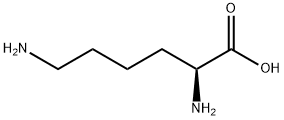
milk. | | Uses | L-Lysine is an essential amino acid used in human nutrition. It plays a vital role in calcium absorption, building muscle protein and recovering from surgery or sports injuries. It is used for the treatment of herpes infections and cold sores. Its derivatives lysine acetylsalicylate is utilized to treat pain as well as to detoxify the body after heroin use. It is an important additive to animal feed. Further, it is used in many foods, especially red meats, fish and dairy products. | | Uses | Essential amino acid for human development. Lysine residues are useful in many cellular processes, due to their ability to accept a wide variety of post-translational modifications. | | Uses | A moderate serotonin antagonist and essential amino acid. | | Uses | lysine is a skin-conditioning amino acid. | | Definition | ChEBI: An L-alpha-amino acid; the L-isomer of lysine. | | Preparation | Produced by fermentation. Also produced by use of continuous ion exchange technology. | | Biotechnological Production | C. glutamicum and, to a lesser extent, E. coli are the main organisms used today
for industrial L-lysine production. The first L-producing strains based on C. glutamicum
were reported in 1961, and those based on E. coli in 1995. The
advantages of using E. coli versus C. glutamicum include the achievement of
higher growth rates at higher fermentation temperatures. The formation of lysine
is highly influenced by two enzymes, aspartate kinase (AK) and homoserine
dehydrogenase (HDH). AK converts aspartate into aspartate semialdehyde, and is highly feedback-inhibited by lysine and threonine. HDH converts aspartate semialdehyde
into homoserine, which is an intermediate for the biosynthesis of threonine,
methionine, and isoleucine. L-Lysine–producing strains therefore often
contain a deregulated AK and/or a reduced activity HDH. Despite the
improvement of the flux from aspartate towards lysine, the availability of key
metabolites from the central metabolic pathways is also essential. Here the formation
of oxaloacetate directly from phosphoenol pyruvate or via pyruvate is
essential for the carbon yield as some unnecessary cycles are included. For
example, inactivation of the enzyme phosphoenol pyruvate carboxykinase, which
catalyzes the reverse reaction from oxaloacetate to phosphoenol pyruvate gave an
improvement in lysine formation. By overexpression of pyruvate carboxylase,
the conversion yield of glucose to lysine could be increased by 50 %. With a
synthetic lysine hyperproducing strain, containing 12 defined modifications from
the wild type, a carbon yield of 0.55 g/g and a product titer of 120 g/L over 30 h
fermentation could be obtained.
Today, however, the main commercial process for L-lysine remains the fermentation
of C. glutamicum. This is performed in fed-batch mode in large-scale
fermenters of up to 500 m3 volume, with production capacities in excess of
100,000 tonnes. The commercial manufacturing process has been comprehensively
described by Pfefferle. | | Aroma threshold values | Detection: 500 ppm | | Synthesis Reference(s) | Journal of the American Chemical Society, 71, p. 3161, 1949 DOI: 10.1021/ja01177a063 | | General Description | L-Lysine is a basic amino acid. | | Safety Profile | An experimental
teratogen. Experimental reproductive
effects. When heated to decomposition it
emits toxic fumes of NOx. | | Veterinary Drugs and Treatments | Lysine may be effective in suppressing FHV-1 infections in cats. | | Purification Methods | Crystallise L-lysine from aqueous EtOH. [Greenstein & Winitz The Chemistry of the Amino Acids J. Wiley, Vol 3 pp 2097-2122 1961, Kearley & Ingersoll J Am Chem Soc 73 5783 1951, Beilstein 4 IV 2717.] |
| L-Lysine Preparation Products And Raw materials |
|


 日本语
日本语 한국어
한국어 Français
 Deutsch
 España
 Türkiye