Other grades of this product :
| Raffinose Basic information |
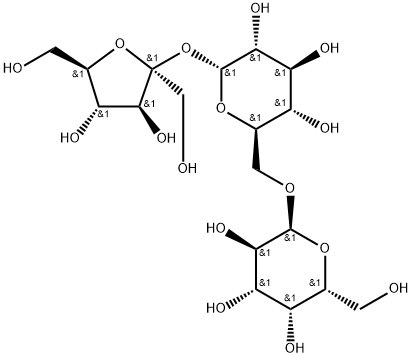
| Product Name: | Raffinose | | Synonyms: | .beta.-D-fructofuranosylO-.alpha.-D-galactopyranosyl-(1→6)-.alpha.-D-Glucopyranoside;.fwdarw.)-;alpha-d-glucopyranoside,beta-d-fructofuranosylo-alpha-d-galactopyranosyl-(1-6;gossypose;melitriose;raffinose,pure;RAFFINOSE;RAFFINOSE, D-(+) | | CAS: | 512-69-6 | | MF: | C18H32O16 | | MW: | 504.44 | | EINECS: | 208-146-9 | | Product Categories: | | Mol File: | 512-69-6.mol |
| Raffinose Chemical Properties |
| Safety Statements | 24/25 | | HS Code | 29389090 |
| Raffinose Usage And Synthesis |
| Description | Raffinose is also called melitose, melitriose, or gossypose.The term raffinose is derived from the French word raffiner (to refine),owing to the fact that it was identified first in the products of beet-sugar refining.Raffinose is found in sugar-beets in small quantities and also in cotton seeds.Raffinose is a trisaccharide composed of galactose, fructose, and glucose. It can be found in beans, cabbage, brussels sprouts, broccoli, asparagus, and other plants. In plants, raffinose is generated via binding of galactinol (a sugar alcohol) to sucrose. Raffinose has only 20 % of the sweetening intensity of sucrose.It is much more readily soluble in hot water than sucrose,consequently it remains in syrups and molasses during sugar refining process,especially in those products obtained from the process of extracting sugarfrom molasses. | | Chemical Properties | Raffinose is a white crystalline powder. It is odorless and has a sweet
taste approximately 10% that of sucrose. | | Uses | D-(+)-Raffinose is an oligosaccharide and trisaccharide whose physical structure and chemical properties have been shown to affect the stability and crystallization of amorphous sucrose, helping to increase the shelf-life of sucrose-containing foods. | | Definition | ChEBI: Raffinose is a trisaccharide composed of alpha-D-galactopyranose, alpha-D-glucopyranose and beta-D-fructofuranose joined in sequence by 1->6 and 1<->2 glycosidic linkages, respectively. It has a role as a plant metabolite, a Saccharomyces cerevisiae metabolite and a mouse metabolite. It is a raffinose family oligosaccharide and a trisaccharide. | | Production Methods | Raffinose occurs naturally in Australian manna, cottonseed meal,
and seeds of various food legumes. It can be isolated from beet sugar
molasses through sucrose separation, seed-crystallization, and
filtration. | | Pharmaceutical Applications | Raffinose is a trisaccharide carbohydrate that is used as a bulking
agent, blood substitute, stabilizing agent, and water scavenger in
freeze-drying where it acts as a stabilizer for freeze-dried formulations. It is also used as a crystallization inhibitor in sucrose
solutions. | | Safety | Raffinose is a naturally occurring trisaccharide investigated for use
in freeze-dried pharmaceutical formulations. It occurs in a number
of plants that are consumed widely. | | storage | Raffinose is stable under ordinary conditions of use and storage.
Excessive heat should be avoided to prevent degradation. Thermal decomposition products are carbon monoxide and carbon dioxide. | | Purification Methods | fructo-furanose [17629-30-0 (5H2O), 512-69-6 (anhydrous)] M 594.5, m 8 0o, 80 -82o, +124o (c 10, H2O), [ ] D +105o (c 1 for pentahydrate, H2O), pK 1 12.40, pK 2 13.44, pK 3 13.52. D(+)-Raffinose crystallises from H2O, 90% aqueous EtOH or MeOH as the pentahydrate. The anhydrous sugar has m 132-135o. It has RF 0.8 on TLC (Silica Gel, and 1:3:3 CHCl3/butanone:/MeOH). The undecaacetate has been purified through an alumina column by elution with CHCl3, and recrystallised from EtOH/MeOH/H2O (3:2:5), with m 99-100o, [] D +92.8o (c 5.14, EtOH). [pK : Coccioli & Vicedomini Ann Chim (Rome) 66 269, 275 1976, 1H NMR: Suami et al. Carbohydr Research 26 234 1973, Beilstein 17 III/IV 3801, 17/8 V 403.] | | Incompatibilities | Raffinose is incompatible with strong oxidizers. | | Regulatory Status | Raffinose is a naturally occurring trisaccharide and is consumed as
part of a normal diet. |
| Raffinose Preparation Products And Raw materials |
|


 日本语
日本语 한국어
한국어 Français
 Deutsch
 España
 Türkiye