Other grades of this product :
| ROSE BENGAL Basic information |
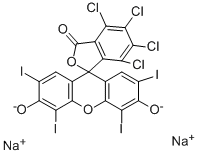
| Product Name: | ROSE BENGAL | | Synonyms: | C.I.AcidRed94(45440);redno.105;CI 45435;FOOD RED NO 105;BENGAL ROSE C.I.NO.45440;ROSEBENGAL1;IFN-α ELISA;LIF ELISA | | CAS: | 11121-48-5 | | MF: | C20H2Cl4I4Na2O5 | | MW: | 1017.64 | | EINECS: | 601-063-2 | | Product Categories: | RB | | Mol File: | 11121-48-5.mol |
| ROSE BENGAL Chemical Properties |
| storage temp. | Keep in dark place,Inert atmosphere,2-8°C | | form | frozen liquid | | color | clear colorless | | EPA Substance Registry System | Rose Bengal (11121-48-5) |
| Hazard Codes | Xi | | Risk Statements | 36 | | Safety Statements | 22-24/25 | | WGK Germany | 3 | | RTECS | LM5920000 | | HS Code | 29329990 |
| ROSE BENGAL Usage And Synthesis |
| Chemical Properties | Rose grows as a plant, shrub, bush or thicket. The flowers exhibit a five-petal calyx and a multiple five-petal corolla. Like the corolla, the seeds are inserted in the calyx. The plant is of Asiatic origin. Countries where rose is extensively cultivated for extractive purposes include Bulgaria, Turkey, Morocco, France and Italy. The parts used are the flowers, buds, leaves and fruit (hips). Rose has a deep, warm, rich rose odor with a slightly bitter, sharp flavor at high concentrations; pleasant on dilution. The fragrance of the rose flower, captured by extraction, is one of the most valuable flavor and fragrance products used. The most common aroma concentrates of rose are rose oil and rose water, derived from steam distillation; and rose concrete and rose absolute from solvent extraction. Of these, rose oil and rose concrete are produced in the largest quantities.The choice of rose derivatives for flavor application is often determined by the feasibility of introducing water-soluble β-phenethyl
alcohol into the flavor complex. This component is present in large quantities in the extracts; it is almost absent in distillates and may,
therefore, have a significant effect on the resulting aroma | | Essential oil composition | The main constituents of rose derivatives include linalool, β-phenethyl alcohol, l-citronellol, nerol, geraniol, eugenol, aldehydes, esters and stearopten (paraffins). | | Purification Methods | This biological stain can be purified by chromatography on silica TLC using a 35:65 mix of EtOH/acetone as eluent. [Beilstein 19 II 261, 19 III/IV 2926.] |
| ROSE BENGAL Preparation Products And Raw materials |
|


 日本语
 한국어
 Français
 Deutsch
 España
 Türkiye